Go/No-Go Criteria for Commercial Door and Hardware Bids
Selective bidding and document rigor beat volume for Division 8 margins.

Division 8 bidding rewards discipline more than it rewards speed. A contractor who scores every opportunity against a fixed set of criteria before spending estimator hours on it will out-earn a contractor who bids everything that lands in the inbox, even if the second contractor wins more jobs in absolute terms. The framework below is built around the specific cost, code, and document risks that make Division 8 unlike any other trade in a commercial bid package, and it ends in a recommendation most shops resist: bid less, not more.
The math of bid selection for a Division 8 contractor
Win rates for competitive subcontractor bids commonly run 20 to 35 percent. Most estimates a shop produces generate zero revenue, just cost, and a trade contractor running 15 bids a month can spend $50,000 or more a month on bid prep alone, most of it attached to work that never closes.
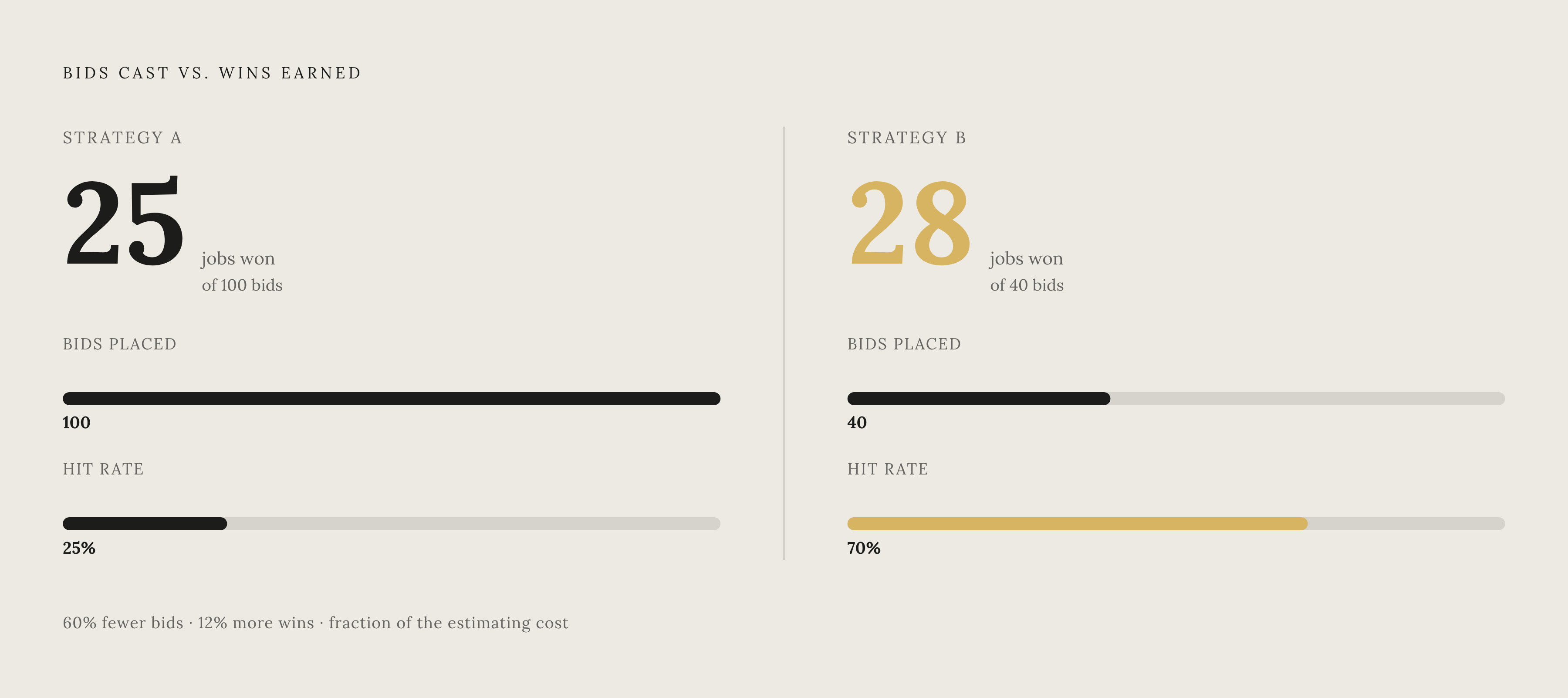
Run two approaches side by side. A shop chasing 100 bids at a 25 percent hit rate wins 25 jobs. A shop chasing 40 qualified pursuits at 70 percent wins 28, spending a fraction of the estimating hours to get there. More wins, less spend, and that gap is not a rounding error, it is the entire argument for filtering hard before takeoff starts. A healthy bid-to-win ratio for hard-bid work is around 5:1. For negotiated and relationship-driven work, 3:1 or better is the target, and a shop running worse than that on either type is paying its estimators to lose.
For Division 8 specifically, the math tilts even further toward selectivity than it does for trades with faster count-and-price workflows. Takeoff here is slow and detail-heavy by nature, reconciling door schedules against hardware specs against floor plans line by line, so every hour spent estimating a job that was never going to be won carries a higher opportunity cost than it would for a trade that can turn a takeoff around in an afternoon.
The four-question first pass that clears the obvious no-bids in 30 minutes
Not every bid needs a full scoring session. A short first pass, done in about 30 minutes, routinely saves 10 to 20-plus hours of wasted estimating effort per disqualified opportunity, and four questions do most of the work.
Strategic fit comes first: does the scope match what the shop genuinely does well? A close miss on sector, building type, delivery method, geography, or project size tends to erode margin even on a job that gets won. Documentation quality is second: is the package complete enough to price with confidence? Drawing and specification coverage, addenda status, and RFI history all speak to this, and gaps at bid stage become contingency or claims later.
Schedule feasibility is third. An unrealistic bid window or construction timeline at the proposal stage usually signals an unrealistic timeline at delivery too, and in Division 8, long material lead times make schedule compression especially punishing. Client and commercial seriousness rounds out the four: is the buyer credible, and are the payment terms, retention, liquidated damages, and insurance requirements acceptable? A flow-down provision that's a dealbreaker is a dealbreaker before the takeoff starts, not after the number gets submitted.
The output of this pass has to be binary. Go, meaning proceed to full review, or no-go, meaning document the reason and move on. That documented reason turns the call from a gut feeling into something trackable across a whole pipeline. Skipping this step lets the damage compound fast: 8 to 16 hours of takeoff on a small single-trade project, or 40 to 80 estimator hours on a mid-size commercial job, get spent before anyone asks whether the job deserved that time.
Division 8 document risk: what makes a drawing package worth pricing or not
Division 8 asks an estimator to reconcile at least three document types at once, not one after another. The door schedule is the tabular list of every opening, with size, material, fire rating, and hardware group number attached to each row. The hardware specification, typically Section 08 71 00, defines what's actually inside each hardware group. The floor plans show where the doors sit, which way they swing, and how they relate to the surrounding walls and partitions.
The schedule and the spec are separate documents doing separate jobs, and a conflict between them is a scope gap waiting to become a change order. A door schedule missing frame types, fire ratings, or hardware group assignments on some rows is a red flag. So is a hardware spec where whole groups sit blank, pending a design decision that never happened.
Fire-rated openings deserve the closest scrutiny of anything in the package. Ratings run 20-minute, 45-minute, 60-minute, and 90-minute at minimum, and each one requires hardware and frame specs actually compatible with that rating. Incompatible hardware on a rated assembly is not a pricing nuance to absorb into contingency, it is a code failure waiting for an inspector to find it. Addenda need the same treatment: does a revision touch the door schedule, the hardware sets, or both, and did the other document get updated to match? A revised hardware group that never makes it back into the door schedule is exactly the kind of conflict an estimator has to catch before pricing, not after.
Floor plans get a cross-check too. A door on a plan but missing from the schedule gets counted from the plan and flagged for the design team, and one or two of those on a job is normal. A large number of them signals a package that was never coordinated. Borrowed lites and vision panels deserve a specific look as well, since they're Division 8 scope that hides inside wall type designations, easy to miss on a fast read.
One rule ties all of this together, and it's the one most estimators underprice: more reconciliation work required to figure out what's being asked for raises the contingency the bid needs to carry, and at some point that contingency makes the number uncompetitive before it's even written down. Incomplete documents don't just cost estimating time. They shift the design team's coordination failures onto the contractor's price.
Code and compliance exposure as a go/no-go filter, not just an estimating input
Division 8 carries life-safety code risk that most other scopes don't touch directly. Fire ratings, ADA clearances, and egress hardware requirements are built into the opening assembly itself, not bolted on afterward. A missed 90-minute rating on a stairwell door doesn't get fixed with a credit memo on the next pay app. It means rework, a failed inspection, and a schedule hit nobody budgeted for, and by the time an inspector catches it, the door is already hung.
The compliance profile of the job needs its own look before committing to bid. Certain facility types carry particularly demanding code overlays, and those jobs simply demand more estimating hours and more compliance expertise than a standard office build. Fire-rated assembly density sets the workload from there: a project where most openings carry a rating requires hardware compatibility verification on every single one, a materially different job than a project where rated doors sit only in a couple of stairwells.
ADA scope adds its own layer. Accessible route requirements mean checking lever versus knob, closer force, and maneuvering clearance across the whole opening count, and a package that leaves ADA compliance underspecified hands that risk straight to the estimator holding the pencil. Electrified hardware and access control raise a different question: when the hardware spec calls for electrified locksets, mag-locks, or access control integration, Division 8 scope starts overlapping with low-voltage work, and figuring out where that boundary sits belongs at the go/no-go stage, not in an RFI filed after award.
In the end, pricing these compliance requirements with confidence instead of with a guess depends on whether the documents give enough clarity. Ambiguous compliance requirements priced with a contingency number tend to produce bids that are either too high to win or too low to survive the job.
Owner and GC quality as a Division 8-specific risk variable
The single highest-leverage variable in any bid decision is the owner relationship, full stop. An owner who pays on time, communicates clearly, and resolves disputes without drama is worth more than the last two points of margin on almost any project, and Division 8 has a specific reason this matters even more here than elsewhere.
Custom frames, specialty glazing, and electrified hardware can carry lead times measured in weeks or more. If an owner is slow approving submittals, or issues a scope change after materials are already ordered, the contractor eats the fabrication cost, and there's no reversing that once the order has gone out the door. GC quality carries the same weight for subcontractors: a GC that runs the design process professionally, turns submittals around on schedule, and pays subs on time is a material factor in whether the job makes money.
A few questions belong on every pre-bid checklist. Has this owner or GC paid on agreed terms on past work? Do they have a track record of scope changes after materials get released, particularly hardware revisions that force a set to be re-specified mid-project? Are the payment terms, retention percentages, and liquidated damages in the draft subcontract livable, or do they create cash-flow exposure the margin can't absorb? Is there a named hardware consultant or AHC on the project? Their presence usually means the hardware spec was written with real precision. Their absence on a complex job is a risk signal on its own, and it should read as one.
A strong-looking job with a weak payer wrecks cash flow faster than a lower-margin job with a reliable owner ever could. That's a go/no-go question, and it doesn't belong buried in a contingency line where nobody has to look at it directly.
Competitive position and capacity determine whether winning would be good.
Two more variables decide whether a win is worth having, namely who else is bidding, and whether the shop has room to do the work.
On the competitive side, a hard-bid public project on a common building type draws multiple serious Division 8 competitors in most markets, while a negotiated project tied to an existing GC relationship might draw one or two. The expected value of any given estimate tracks directly with how many serious competitors are chasing it, so the same hours spent on a thin field are worth more than the same hours spent on a crowded one. Public procurement with no pre-qualification, a wide invitation list, a building type every local shop can handle, and no specialty scope to narrow the field signals a crowded field. A prior relationship with the GC or owner, specialty scope like electrified hardware or complex fire-rated assemblies that few shops can credibly bid, and negotiated or design-build delivery signals a favorable one.
Capacity is the other constraint, and it's the one shops tend to ignore until it's too late. A mid-size commercial project commonly needs 40 to 80 estimator hours to bid, a real chunk of a finite resource, and if the estimating team is already stretched across bids closer to award, a new pursuit landing in the same window is competing for hours that don't exist. Backlog matters on the delivery side too: winning a job the field crew can't execute on schedule turns into a delivery problem, and in Division 8, long material lead times make field delays especially hard to recover from once they start. Bidding to keep the pipeline full is a legitimate reason to take on a marginal job. That should be a deliberate call, though, not the default outcome of skipping the filter.
The two variables interact, and the interaction is where the real decision lives. A crowded field on a job that would also strain capacity is a clean no-bid, no further discussion needed. A favorable competitive position on a job sitting at the edge of capacity is worth a real conversation before the takeoff starts, not after 60 hours are already sunk into it.
Turning the criteria into a scored decision with a built-in veto
Most experienced bid teams sort these criteria into six categories: strategic fit, client and payment risk, project definition, competitive position, capacity and capability, and commercial terms. A weighted scoring matrix applies different weights to each based on what matters most to the specific shop. One commonly cited default assigns strategic fit 25 percent, competitive position 20 percent, and strategic value 10 percent, with the remaining weight distributed across risk, capacity, and commercial terms.
Decision thresholds follow from the score. A total at or above 75 percent supports pursuit without much debate. A score between 40 and 74 percent is conditional: the bid can move forward, but only after specific risks get named and addressed, whether that means negotiating a payment term, requesting a schedule extension, or getting written clarification on a hardware group before committing hours to it. Below that range, the math argues for passing, and arguing with the math at that point is just ego.
The system needs one more feature to actually work in Division 8, and it's the one most matrices leave out: a veto. No weighted average should override a hard fail on fire rating compatibility, an unacceptable payment structure, or a document package too broken to price with any confidence. A job can score well overall and still deserve a no-bid if a single category represents a risk the shop can't absorb, financially or legally. The scoring matrix earns its keep by forcing the conversation into the open. The veto earns its keep by making sure a good score on paper never talks a shop into a bid it already knew, going in, not to chase.