Building a Division 8 Estimating Playbook for Business Continuity
Mastering the relational skill that prevents Division 8 errors from surviving to submittal.
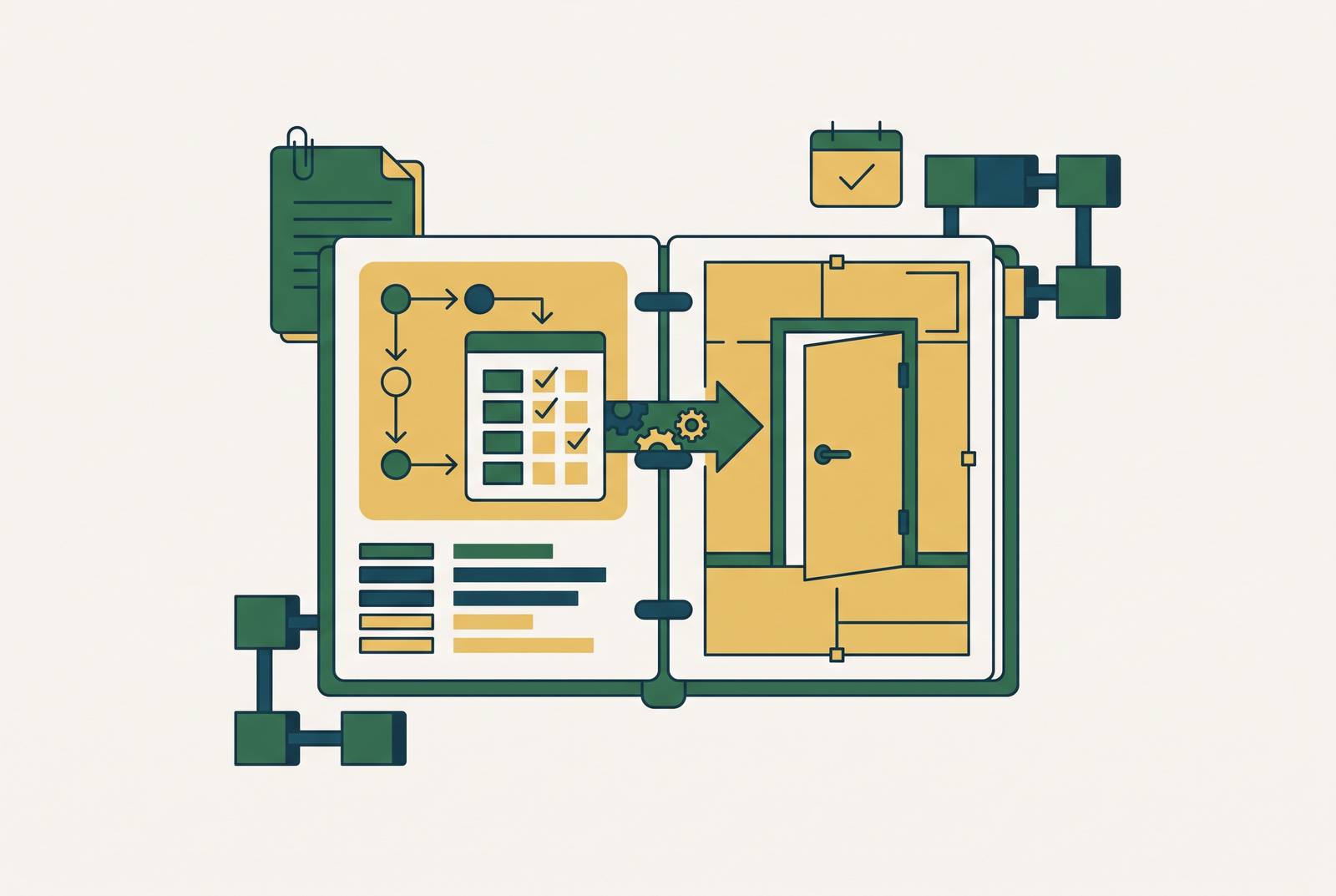
Division 8 looks, from the outside, like a counting exercise: count the doors, price the hardware, move on. The actual work is the ability to hold multiple document types in relationship at the same time, because door schedules, hardware schedules, floor plans, elevations, and specs all govern the same opening simultaneously. An estimator reading a door schedule is never just reading a door schedule. The width, the height, whether it's a single leaf or a pair, the fire rating, the hardware group assigned to it, all of that has to be checked against a specification that lives in an entirely different document, because hardware schedules are set up in specs rather than shown on drawings. That single structural fact forces constant movement between two documents that were written by different people, often at different points in the design process, and reconciling them is the actual skill. It cannot be taught as a checklist because it is not sequential: it is relational knowledge, and relational knowledge is exactly the kind that evaporates when the person holding it in their head leaves the firm.
Where errors originate in the manual takeoff process
Most Division 8 errors do not originate from an estimator making a careless mistake. They originate in a workflow that reads one document at a time and asks a human to reconcile them from memory, so that reconciliation happens in the estimator's head instead of on the page. The data an estimator receives at bid time is rarely internally consistent: hardware specs list components with no quantities attached, door schedules reference hardware sets that don't actually appear in the spec, and hinge counts are frequently left unspecified on the assumption that whoever is pricing the job will size them off the door dimensions. The contractual obligation to catch these problems is explicit. Contractors are required to notify the architect of any discrepancy between the door schedule, door types, drawings, and scheduled hardware, and to proceed only once that discrepancy has been resolved in writing. Meeting that obligation requires reading every governing document at once, which is the same relational skill that makes Division 8 hard to transfer in the first place.
A concrete example of how formatting choices can quietly produce these errors appeared publicly in 2025, when detailer Emilio Bendever pointed out that a platform he worked with reported hardware quantity as a total across all openings in a set, rather than broken out per door. That single design decision pushes real math onto the customer or architect reviewing the submittal, who now has to back-calculate the correct quantity per opening before they can even check the estimator's work. Errors introduced this way are not visible at takeoff; they appear at submittal, which is the most expensive possible place to find them, because by then pricing has already been built on the error. The specification itself anticipates this kind of failure mode: it requires the hardware contractor to coordinate with hardware templates, confirm that fire rating classifications override conflicting details elsewhere in the documents, and flag conflicts to the architect before anything gets fabricated. Those obligations only function if someone is reading the full document set in relation to itself, and a sequential, document-by-document process is structurally incapable of guaranteeing that.
What a Division 8 estimating playbook needs to contain
Frames, doors, and hardware come out grouped and counted, with singles separated from pairs, and every line traceable back to the specific page and table it came from. But sequence alone doesn't prevent the errors described above. What prevents them is a set of explicit cross-checks written down for every opening: door type and material checked against the schedule, gauge and core material and fire rating and finish checked against the spec's Part 2 product definitions, the hardware set itself checked against the 087100 section, and handing and frame type checked against the floor plan and elevation details. Each of those checks exists because experienced estimators already do them, automatically, without being told to. A playbook's job is to make that automatic behavior visible and repeatable for someone who hasn't yet built the instinct.
The playbook also has to account for the fact that construction documents routinely leave things unstated, trusting the estimator to fill the gap correctly. Hinge count gets inferred from door height and size, kick plate dimensions get sized off door width, and intumescent seal requirements get triggered by fire rating even when no document says so explicitly. These inferences are judgment calls that live entirely in an experienced estimator's head, and when that person leaves the firm, the inferences leave with them unless they've been written down.
The scope those rules have to cover is wider than doors and hinges. Division 8, under CSI's Openings classification, includes hollow metal doors and frames, commercial wood doors, architectural hardware such as hinges, locksets, closers, and panic hardware, and specialty categories like fire-rated assemblies, tornado-rated doors, and lead-lined doors, alongside glazing, windows, storefronts, and curtain walls. Each of those categories carries its own specification logic, and a playbook that treats them as interchangeable will miss the category-specific judgment calls that matter most. The Northern Arizona University technical standard is a useful illustration of how granular this gets in practice: it specifies institutional-grade doors across the board, interior hollow metal door faces at a minimum of 16-gauge, exterior frames at 14-gauge, and welded frames required for new construction, with knock-down frames needing advance approval before they can be substituted. None of those rules generalize to the next project. They have to be captured explicitly, by owner, rather than assumed to carry over from one bid to the next.
Institutional owner standards and playbook complexity
Institutional work raises the difficulty of the playbook's job from reading what the spec says to constructing what the spec never fully states, and the gap between those two tasks widens the further an owner departs from a conventional hardware schedule. The University of Southern California's Health Sciences Campus specification sits on the easier end of that range: it requires final hardware sets to be coordinated with doors, frames, and related work for size, thickness, hand, function, and finish, and it supplies default finishes of BHMA 626 or BHMA 630 as a fallback. An estimator working against that standard has defaults to anchor to even where project-specific direction is thin.
The University of Houston's master specification asks for more active cross-referencing. Its hardware schedule has to include the identification number, location, hand, fire rating, size, and material of each door and frame, and every hardware set has to be cross-referenced both to the floor plans and to the door and frame schedule. That's a procedural obligation that a playbook has to walk through step by step for an estimator who hasn't worked this owner's standard before, because missing one of those cross-references is exactly the kind of error that survives to submittal.
Michigan State University sits at the far end. Its specification publishes no hardware sets whatsoever. The 13-page section is entirely Part 1 General, organized alphabetically from A through M by component type across nine separate tables, and the estimator has to match each opening's usage to the correct row and repeat that process nine times per opening. There is nothing to extract here. The estimator is building the hardware set from raw component tables, which is a fundamentally different cognitive task than reading a pre-assembled set off a page, and a playbook that only teaches extraction will fail completely on a job like this one.
Other owners add process gates on top of the technical requirements. Ivy Tech's standard requires hardware selections to follow a campus hardware standard for uniformity, with a review involving the Owner and a separate review of the door and hardware schedules by the Service Area Director of Facilities, a meeting the architect is responsible for scheduling. Missing that review during bid prep is a scheduling failure, and it's exactly the kind of failure a playbook exists to prevent. Across all of this sits the Door and Hardware Institute's Sequence and Format for the Hardware Schedule, the named industry standard governing how hardware schedules are built in Division 08 documents, under which the entity furnishing the doors and hardware is responsible for producing the schedule, building it from the specification in conjunction with the drawings, and submitting it back to the architect for approval before anything is ordered. A playbook has to encode that responsibility chain explicitly, because the chain is different on every institutional job and assuming it is a way to miss an approval step.
Where AI takeoff fits into the playbook
AI-powered takeoff tools change the content of the playbook rather than replace it, because what they automate is extraction and cross-referencing, the steps that previously required an estimator to hold four documents in working memory at once. That shift lets the playbook's emphasis move from teaching someone how to read four documents simultaneously toward teaching them how to review what a system has already produced and where to push back on it. As of 2026, Division 8-specific AI systems handle that extraction and cross-referencing directly, generating structured output such as automatically sized preps, components sized to match the door's own characteristics, and hardware sets split wherever a door's attributes require it: an 8-foot door that needs four hinges instead of three gets flagged and split automatically, a fire-rated opening that requires an intumescent seal gets the seal added without being asked, and a kick plate gets sized to the door's width.
None of that removes the estimator from the process. The workflow that holds up in practice pairs AI extraction with estimator review, particularly on high-dollar or contradictory openings, where the estimator's job is to spot-check exit devices, electrified hardware, rated openings, unusual functions, pairs, and anything the software has flagged as inconsistent across documents. The strongest argument against treating AI as a full replacement for human estimating holds up under scrutiny: pricing strategy, local condition adjustments, risk assessment, contingency planning, and scope negotiation stay entirely in human hands, so the playbook still has to encode that judgment layer even once it no longer has to encode the counting layer. A general-purpose takeoff tool, built for trades that don't carry this kind of document interdependency, will underperform on Division 8 specifically because it cannot read the relationship between the 087100 spec, the door schedule, and the owner standard at the same time. The playbook's job, then, is to specify which tool is appropriate for which class of job, and to say directly why a generalist tool will not hold up on an institutional bid.
Bid Volume Without Proportional Headcount Growth
A contractor wins more work by being able to quote more jobs accurately, not by asking the same senior estimators to work longer hours, and a playbook is the piece of infrastructure that makes that possible without the firm depending on any single person's memory. The competitive environment in 2026 no longer rewards volume-based bidding on its own: market volatility, labor shortages, tighter margins, and more complex projects have raised the bar for what a competitive bid has to look like, and firms still bidding on volume or gut instinct are spending time and money for diminishing returns. Because most contractors win only a minority of the bids they pursue, and because each bid can cost thousands of dollars to prepare, an unfocused bidding strategy erodes profitability fast. A playbook's contribution here goes beyond speeding up takeoff. It makes go/no-go decisions faster and more consistent across whoever is making them.
Pricing pressure compounds the stakes. Industry survey data shows aggressive pricing competition is a major challenge for most contractors in 2026, with everyone bidding tighter even as input costs climb, squeezing margins from both sides at once. A playbook that encodes escalation clause triggers and contingency rules as standing checks, rather than something a senior estimator remembers to add case by case, protects margin at the scale a firm is trying to operate at. The deeper effect is distributional. A playbook spread across a team gives a smaller operator or a distributor the same estimating leverage that larger firms have historically held simply by employing multiple senior estimators. It is a minor efficiency gain that becomes the mechanism by which a firm competes on more bids without adding headcount in proportion to that volume.
Building the playbook: what to document first
The highest-value place to start is not the obvious procedural steps but the inferences experienced estimators make without being asked: how hinge count gets derived from door height, how a contradiction between schedule and spec gets flagged and escalated, and which owner standards demand that a hardware set be built from scratch rather than simply read off a page. Those are the pieces of judgment that disappear first when someone leaves, because they were never written down to begin with.
Structure matters once that content exists. The playbook should be organized by document type first and opening category second: start with the 087100 spec and its Part 2 product definitions, move to the door schedule fields and what each one must be checked against, then to the floor plan and elevation cross-checks, and finally to hardware set construction or extraction depending on the job type in front of the estimator. Institutional work needs its own module layered on top of that structure. For every owner standard a firm bids regularly, whether it follows a cross-referencing protocol like the University of Houston's or a from-scratch, table-matching format like Michigan State's, the decision rules for that owner should be written out as a named profile rather than left in one estimator's memory.
A playbook stays current only if it's tied directly to outcomes. Every submittal rejection, every RFI raised over a hardware conflict, and every pricing error traced back to a missed spec requirement is a signal that the playbook needs an update. The quantity-per-set versus total-per-item dispute that produces submittal rejections is a known failure mode, and it belongs in the playbook as a standing check precisely because it has already happened and will happen again on the next job that extracts data the same way. A playbook built this way is a running record of every reconciliation an estimator has ever had to make by hand, with each entry a piece of institutional knowledge that no longer depends on one person staying at the firm to be useful.