Estimating Hours as a Bid Selection Filter
Screening bids upfront by estimated hours cuts wasted pricing work before it starts.

Every hour an estimator spends on a Division 8 takeoff is money spent before a single door gets ordered, before a contract exists, before there's any guarantee the job even goes to bid on schedule. The instinct in most estimating departments is to bid everything and see what sticks. That instinct ignores the basic arithmetic of the trade: estimator hours cost money whether or not the bid wins, support staff hours cost money, and every hour spent on one bid is an hour not spent qualifying or pricing something else. A single bid can run in the neighborhood of $3,500 in direct labor before anyone counts what else could have been priced with that time. Given that most commercial contractors win somewhere between one bid in five and one in three, something like 70 to 80 cents of every dollar spent on estimating produces no return at all. That's a selection problem, not a productivity problem to be solved by working faster, and the fix belongs upstream of the takeoff, not inside it. It's a selection problem, and the fix belongs upstream of the takeoff, not inside it. The premise of this piece is straightforward: the expected hours to complete a Division 8 takeoff should get calculated before a single drawing opens, and that number should drive the go or no-go decision.
How Division 8 takeoff hours vary from job to job
General construction gives a rough sense of scale. A $500,000 commercial retrofit might take 20 to 30 hours of bid prep; a $5 million industrial job can eat 150 or more hours across several people. Division 8 breaks that pattern because the scope is measured in openings, hardware sets, and the number of places where documents disagree with each other. It's measured in openings, hardware sets, and the number of places where documents disagree with each other.
A mid-size commercial project spanning three to five floors can carry 180 to 400-plus individual door openings, and each one drags its own fire rating, frame type, hardware set, and ADA requirement behind it. A single opening's hardware set can run 15 or more line items on its own. Multiplying that across a few hundred doors means the gap between a clean project and a messy one stops being linear. It compounds.
Part of what drives that compounding is the sheer number of documents that have to line up. Door schedules, elevations, floor plans, and the 087100 spec section all have to get reconciled at the same time, not one after another. Working through them sequentially is exactly how misses occur: a hardware set that reads one way in the schedule and another way in the spec doesn't announce itself, it just sits there until someone catches it, usually late.
Institutional work adds a fifth layer on top of all this: owner standards that override or supplement whatever the project spec says. As a result, the estimator ends up authoring hardware sets rather than pulling them straight off the page. That distinction matters enormously, and it's covered in more detail below.
Put it together, and two jobs that look identical on the invitation to bid, same dollar value, same building type, can differ by a factor of three or four in actual takeoff hours. The invitation tells you almost nothing about what it's going to cost to price.
Factors that make a Division 8 document set hard to price
Some signals are visible before the estimator commits real time, if someone knows to look for them. Hardware set count is one of the biggest. A project carrying 40 or more unique sets means pricing each one individually, and when the door schedule and the hardware spec don't agree on which door gets which set, review time multiplies rather than adds.
Scope boundaries matter just as much. Some specs, including Santa Fe's, use an "OT" convention to hand certain lines off to other trades, and those lines need explicit exclusion from the Division 8 bid. Missing one causes the bid to come in inflated. Catching them all takes time that isn't accounted for anywhere on the invitation to bid.
Emilio Bendever, a working detailer, and Lori Greene, Manager of Codes and Resources at Allegion, dispute whether a hardware set's line-item quantities represent quantity per set or total quantity across all doors using that set. This is an active point of disagreement in the trade, and the two have taken different positions on it. If a piece of takeoff software defaults to one convention without flagging it, the number that comes out looks perfectly reasonable and is wrong by a multiple, across every single set in the project.
Addenda cadence is its own hazard. Hardware sets that change two days before bid day compress whatever time remains, no matter how much of the takeoff is already finished. And electrified or access-control hardware is easy to under-price on a fast turnaround, because the coordination note that ties it to Division 26 or Division 28 is often buried several pages deep in the spec, not sitting where anyone would think to look for it first.
Before opening a single sheet, an estimator can scan the cover sheet for door count, the spec index for the number of hardware sets, the finish schedule for completeness, the addenda history, and the project manual for any flagged owner standard. None of that takes more than a few minutes, and it tells you more about the job than the dollar value on the invitation ever will.
How institutional owner standards change the takeoff's cost profile
Owner-standard specs get treated as the easy case. Owner-standard specs get treated as the easy case, but they shouldn't be. They're not a simpler version of a project spec; they're a different task altogether: instead of extracting hardware sets that the spec has already assembled, the estimator has to author sets against whatever standard the owner has published.
Cornell University's Design and Construction Standards make the mechanism explicit. The standards set mandatory design constraints and list acceptable or required products for Cornell construction work, and any deviation needs University Engineer approval. Cornell's own documentation states that the hardware sets represent design intent only, that they're a guideline rather than a detailed hardware schedule, and that discrepancies should get resolved before bidding. In practice, that means the estimator inherits an unfinished document and is expected to finish it.
Cornell's published standard includes 23 hardware sets with no finish codes stated anywhere, not one BHMA numeric among them. All 23 sets list the hinge line as "3 Hinge As Required," which tells an estimator nothing about quantity or spec. Six proximity reader lines reference a model number that's only obtainable by phone call. By rough count, a significant share of the line items in that standard carry nothing an estimator can actually price off the page.
An owner-standard job looks organized on first glance, because a standard exists and someone clearly put thought into it. But it's often more hour-intensive than a genuinely disorganized project spec, precisely because the burden of finishing the schedule has shifted onto the bidder. That should factor into the go or no-go call as its own line item, not get assumed away because "owner standard" sounds like a synonym for "clean."
The offsetting consideration is that preferred-vendor status and repeat-client relationships carry value that a one-off project spec never will. But that value needs to be weighed explicitly against the hour cost, not assumed to cover it automatically.
Estimating takeoff effort before committing: a practical framework for Division 8
Research on bid qualification points to a consistent pattern: a qualification pass of roughly 30 minutes can save 10 to 20-plus hours of wasted estimating effort on a job that was never going to work out. The goal isn't to eliminate judgment, it's to make that judgment happen systematically and early, before the sunk cost starts piling up.
Step one is a binary knockout, and it should take five minutes or less. Does the work fall inside the type this shop actually does, in a region it can serve, at a bonding capacity it can support? Is the client commercially serious, with a real budget and a real timeline, as opposed to someone fishing for a number to shop around? Does the schedule work, given the bid due date, the award date, and the project start? A failure on any of these is a pass, immediately, no further analysis needed.
Step two is a document complexity score, and it shouldn't take more than half an hour. The estimated door count can be taken from the cover sheet or spec index. Count the unique hardware sets. Check how much of the finish schedule actually carries finish codes. Flag whether this is a project spec or an institutional standard, because institutional adds hours almost by definition. Note the addenda count and how recent the changes are, since late hardware-set addenda act as a multiplier on remaining hours. And check the index for Division 26, 27, or 28 coordination notes that signal electrified or access-control scope.
Step three converts that score into a real number and a real cost. A clean project-spec job with a complete finish schedule and under 200 doors sits in one hour range. An institutional owner-standard job with 300-plus openings and incomplete sets sits in a completely different one, and treating them as comparable is where the estimating budget quietly bleeds out. Multiplying the hour estimate by a fully-loaded estimator rate produces the figure that is the actual cost of pursuing the bid. Compare it against expected margin on the project multiplied by the realistic win probability.
Step four is where the decision gets written down, not just made. Why this job, at this hour cost, against this win probability. That record is what turns a one-off judgment call into data that sharpens the next hundred judgment calls.
Win rates give the framework its context. Hard-bid public work tends to run around 10 to 20%. Private competitive work runs 15 to 25%. Firms that pursue selectively and lean on repeat clients see 30 to 50%. The filter's entire job is to push a portfolio toward that upper range, deliberately, rather than hoping volume gets there by accident.
What win-rate data says about volume versus selectivity
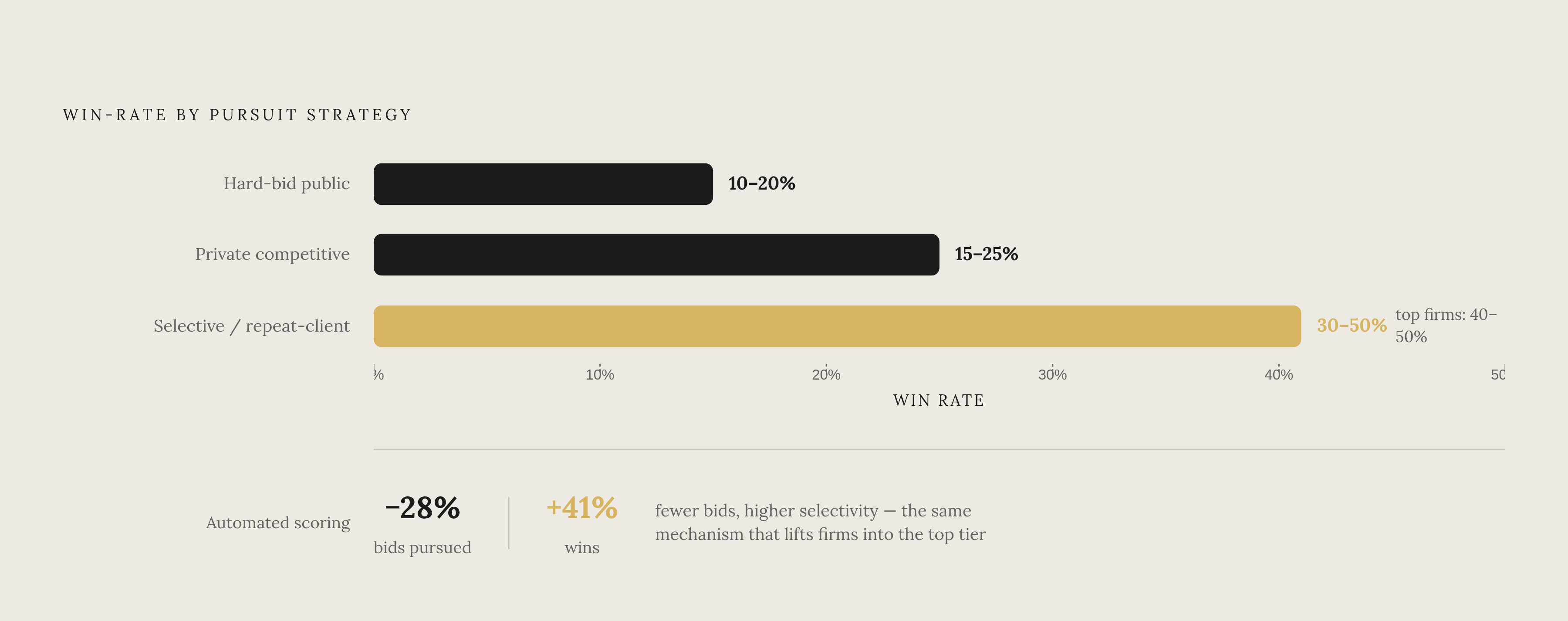
Data pulled from more than 1,000 construction projects points to something that runs against the instinct to bid more: the highest-performing contractors consistently land win rates of 40 to 50%, a benchmark that firms pursuing selectively and focusing on repeat-client work also reach. The gain comes from picking better targets: the highest-performing contractors land win rates of 40 to 50%, consistent with what firms pursuing selectively and leaning on repeat clients achieve.
Margin data backs this up. GC margins climbed from 9.1% in 2024 to 10.7% in 2025 even as backlog shrank, which is the signature of contractors getting pickier rather than busier. Firms using automated opportunity scoring reportedly pursue 28% fewer bids while winning 41% more of them, which is about as direct a confirmation of the selectivity thesis as the data gets.
For a Division 8 sub, the same job might get priced to three or four different general contractors, so effort per bid and win rate per project are two separate things to track, not one. Conflating them hides where the real problem sits.
The practical upshot: bidding fewer jobs is not a threat to revenue if the freed-up hours go toward better-fit opportunities. It's a revenue strategy in its own right, because an estimator who finishes a high-probability bid with time left over, time that would have gone to a low-probability one, has added capacity without adding a single headcount.
Consider the shape of a bad outcome at scale. A full estimating team spends 320 hours pricing a sizable medical office building, comes in second, and gets told the number was." Then the same team does it again on the next one. Those 320 hours were real capital, spent and gone, and "really close" doesn't refund any of it.
The effect of AI-assisted takeoff on the hour-cost calculation in the filter
Faster takeoffs don't retire the filter. They shift its inputs. A bad-fit job priced twice as fast is still a bad-fit job, and it still returns nothing. What changes is the hour-cost figure that step three of the framework produces, and that shift matters most on the marginal cases: jobs that would have been correctly passed over at manual-takeoff speed can cross into worth-pursuing territory once the capital required to price them drops.
There's evidence that automated bid matching and predictive scoring, driven by one model, lift win rates by something in the range of 22 to 31%. That's a targeting gain, not merely a speed gain, and the distinction matters for how a shop should think about the technology.
Division 8 poses a specific challenge here. General-purpose takeoff software doesn't parse the relationship between hardware sets and openings, doesn't flag the quantity-per-set-versus-total ambiguity that trips up so many bids, and doesn't reconcile the multiple conflicting document types that a Division 8 takeoff requires. A tool built specifically for the trade addresses the document complexity that drives hour counts up in the first place, rather than just moving faster through a generic takeoff workflow.
The capacity argument follows naturally from that: an estimator who finishes a full Division 8 takeoff in a fraction of the manual time can chase more well-targeted bids in the same window. That's how a smaller shop or distributor starts competing on the same footing that large firms have historically bought with headcount alone.
None of this eliminates the go or no-go filter, though. It makes the filter more forgiving on hour-cost while leaving it just as necessary on strategic fit, win probability, and client quality. Whether a client is serious, whether the competitive field makes sense, whether the relationship is worth pursuing: none of that gets resolved by a takeoff tool. Those calls still get made by a person, before the tool is ever opened.
Tracking bid-cost data to sharpen the filter over time
The filter only gets sharper if someone actually measures the inputs, including real hours spent per takeoff, not the estimate made going in, the win or loss outcome, and the go or no-go call that was made at the time. Without that record, every future decision is still a guess dressed up as judgment.
Two numbers deserve separate tracking for a Division 8 sub. Effort per bid, meaning hours committed to pricing it. And win rate per project, meaning whether the project actually got awarded to a GC who used that sub's number. Blending these two into one metric produces a distorted picture of where the real problem sits, either in bid selection or in the win rate downstream of the GC relationship.
Over time, the data should start answering a few concrete questions. Which of the document complexity signals from step two actually predicted long takeoffs, and which ones turned out not to matter at all? Does win rate differ meaningfully between project-spec jobs and owner-standard jobs once dollar size is held constant? And did the 30-minute pre-screen catch bids that would have been lost anyway, which is the clearest measure of the filter's own return on investment.
Capacity constraints are already forcing the industry's hand here. The AGC's 2025 Workforce Survey found that nearly one in five general contractors turned down work because they lacked the labor to build it. Selectivity is already happening. Tracking bid cost just makes it a deliberate choice instead of a reactive one forced by staffing shortfalls.
An estimator who knows what a Division 8 bid actually costs to produce, and what it returns at the shop's historical win rate, can have a fundamentally different conversation with ownership about how many bids to chase. That conversation should run on preconstruction economics, not on activity counts. Bidding more jobs was never the path to winning more work. Bidding the right jobs, at a known cost, against a known probability of winning, is.