Institutional vs. Commercial Project Mix for DFH Contractors
Institutional work requires checking owner standards that commercial specs don't demand.

The institutional-commercial mix and its current relevance
Institutional and commercial construction do not run on the same estimating logic, and treating institutional work as a bigger version of commercial is a mistake that appears on bid day, after the number's already locked in. The gap is structural: who writes the specification, how the documents get organized, and what the door and hardware (DFH) contractor has to reconcile before a price ever reaches the bid form. Get that distinction wrong and no amount of estimating hours will save the number.
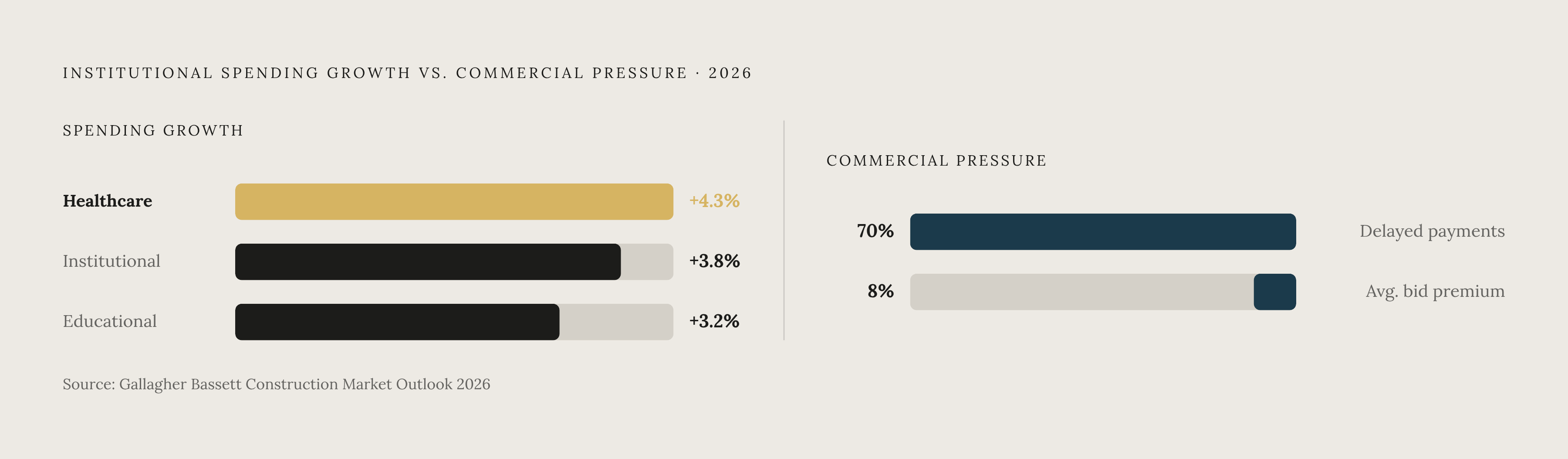
Institutional construction is the strongest part of the 2025-2026 cycle, and the data backs that up cleanly. The Gallagher Bassett Construction Market Outlook 2026 projects overall institutional spending to rise 3.8% in 2026, with healthcare construction forecast to grow 4.3% and educational construction 3.2%, both pushed by demographics, aging buildings, and state and local government spending. Deloitte's Engineering and Construction Industry Outlook found that commercial and institutional planning activity climbed 30% year over year, a number that sounds like a broad boom but one that reflects concentrated activity rather than uniform growth across all commercial sectors.
Commercial's problem sits on the margin side. Margins on commercial work stay squeezed by material inflation and inconsistent cash flow, and payment risk compounds it: 70% of contractors regularly face delayed payments, and firms have raised bids by an average of 8% just to protect against slow-paying clients, according to a national study from Built (Talker Research) cited by starcsystems.com. A retrofit wave is also building on the institutional side, with schools, hospitals, and municipal buildings pursuing lock and hardware upgrades that run on a different cycle than ground-up construction.
Institutional growth is durable and backed by public funding. Commercial growth is real but concentrated in a handful of sectors and squeezed on margin. For a DFH contractor deciding where to put estimating hours, that difference is the whole calculation. It's the whole calculation.
How Division 8 documents are structured on a commercial project, and the estimator's resulting task
Division 8 in the CSI MasterFormat covers openings: doors, frames, hardware, glazing, and everything that goes with them. Division 8 sets the materials, the performance requirements, the installation methods, and the quality standards for every opening on the job. The specification is the contractual basis for the hardware package, and any deviation from it needs formal sign-off through the submittal process.
On a commercial job, the architect or a certified Architectural Hardware Consultant (AHC) writes that spec and issues it as part of the project manual during bidding and construction. The estimator works from a handful of key sections: 08 11 00 for metal doors and frames, 08 14 00 for wood doors, 08 71 00 for door hardware (the section that matters most to a hardware distributor, since it covers hinges, locksets, closers, exit devices, stops, and seals), 08 41 00 for entrances and storefronts, and 08 80 00 for glazing.
Hardware sets, sometimes called hardware groups, are numbered lists like HW-1, HW-2, HW-3, each one spelling out the full hardware package for a given door type. Every opening on the project gets assigned to one of these groups through the door schedule, a separate tabular document on the architectural drawings that lists door number, size, material, fire rating, glazing requirements, and hardware group for each opening. On a large commercial project, that schedule alone can run to hundreds or thousands of openings.
On a self-contained commercial project, the spec, the door schedule, and the plans are the entire universe of information. The estimator's job is to reconcile those three against each other, and nothing outside that set governs the hardware package.
The estimating risk commercial document sets create, and its compounding on institutional jobs
Mistakes happen constantly, even inside that closed universe. Errors and inconsistencies between the door schedule and the hardware spec are a common source of delays and change orders. Bid-day scope gaps rarely come from one glaring omission; They tend to sit in the seams, between the door schedule, the spec, and the long-lead items.
A well-built RFI for a schedule/spec conflict names the exact door and states the conflicting language from each document: "Door D-301 schedule calls for a Grade 1 lockset; Spec 08 71 00 requires Grade 2 locksets for all interior doors. Which governs?" Specificity matters because vague RFIs get vague answers, or no answer at all until it's too late to matter.
Standard bid documents commonly resolve some of this by rule: figured dimensions take precedence over scaled drawings, and any discrepancy goes to the architect. Poorly coordinated sets share recognizable tells: the wrong city named in the general notes, standard details that have nothing to do with the actual project, a finish schedule naming one material while a detail elsewhere shows another, and references to details that were never included.
That's the baseline risk on commercial work, and institutional jobs stack a layer directly on top of it. The estimator now has to check the project documents against the owner's own master standard, a third document set that can override what the architect wrote. If that standard is missed, the hardware package priced might be perfectly compliant with the project spec and still get rejected by the owner during submittal review. That's a substitution risk, a change-order risk, and a schedule risk with no equivalent on commercial work. Drew Tiemann noted on LinkedIn that Division 8 specs create real problems when they don't line up with architectural plans or security requirements, when products aren't compatible with each other, or when code compliance gets missed. Institutional jobs just add more items to that list.
What owner standards look like and what they require the estimator to do differently
Universities, health systems, and government agencies routinely publish their own master Division 8 standards, and those standards sit above or alongside whatever the architect wrote for the individual project. They pre-select approved manufacturers, lock brands, keying systems, and access control platforms, often by name, which turns "performance-equivalent" into a phrase that doesn't apply.
Texas A&M University's 2025 Design Standards make the point directly. Locksets for new construction and major renovations have to be Medeco heavy-duty mortise type with key-removable core cylinders, a specific manufacturer named outright rather than a generic performance class. Door closers have to be LCN or Sargent. Hinges have to be McKinney, Hager, or Stanley. Anything else needs sign-off from the university's Building Access Services office, and the standard also requires a Hardware Consultant (AHC) on hand throughout the work to advise the contractor, the architect, and the owner on both standard and electromechanical hardware and keying.
Western Washington University runs a similar model: the hardware supplier has to be a direct factory contract supplier employing a certified AHC available at all reasonable times during the work, and every lockset and exit device cylinder has to be removable and compatible with the university's proprietary key system.
A deeper regulatory stack sits on top of all this, one most commercial jobs never touch, including ANSI A117.1, the IBC, NFPA 80, NFPA 101, NFPA 105, and the ANSI/BHMA A156 series. A contractor who bids the project spec without ever pulling the owner's standard can end up pricing hardware disqualified before it reaches submittal, and the mistake stays invisible at bid time. Nobody catches it until the paperwork comes back stamped "revise and resubmit." On jobs where the owner requires an AHC on staff or under contract, that credential is a bid condition, not a preference. Without it, the contractor doesn't get to bid.
How the estimating workflow changes between a commercial and an institutional takeoff
A commercial takeoff runs through roughly five manual steps. Pull the hardware set data out of the 08 71 00 spec, usually a PDF read by hand rather than imported directly. Reformat that data into whatever structure the estimating platform expects. Cross-reference every hardware set against the door schedule, where mismatches surface, a door listed under set 107.3 in the schedule but 107.4 in the spec, say, and each mismatch requires a judgment call about which document is right. Then enter everything into the estimating platform, which on a large job can mean hundreds of line items, each with its own hinge count, closer size, kick plate width, finish, and function.
Institutional work adds steps before that process starts and inserts more into the middle of it. First, find the owner's master standard, which isn't always linked anywhere in the project manual and sometimes takes real digging to locate. Read that standard against the project spec, line by line, to find where they conflict or where one is silent and the other isn't. Where the owner names a manufacturer, Medeco or LCN, for instance, and the project spec allows something more open, decide which one governs and write that decision down. Build hardware sets that satisfy both documents at once. This means authoring a solution rather than extracting one that already exists on the page. Then document every place the final hardware package departs from the project spec because the owner standard demanded it, since that documentation is what gets reviewed at submittal.
That labor adds up fast. Listings on jobs.recorder.com show job postings for chief estimator roles on ground-up Division 8 work sometimes calling for leading teams of up to nine estimators, a sign of how much manpower this work takes at scale. Some estimators, according to a user post in a Comsense Estimating forum thread on commdoor.com, handle hollow metal doors, frames, and prep work entirely on paper at bid time and only enter the job into the estimating platform once it's won. That shortcut holds up fine on a commercial bid. It falls apart faster on an institutional one, where the hardware package is more complicated and the owner's review process has a lot less patience for shortcuts.
Some newer tools built specifically for Division 8 takeoff can pull door schedules and hardware sets straight from plans and specs, standardize the data, and match openings to hardware sets automatically, even sizing components like kick plates, thresholds, and astragals based on opening dimensions. That kind of tool compresses the extraction and cross-referencing work considerably. It won't do the authoring step against an owner standard on its own, that still takes a person who understands what's being reconciled, but it clears enough of the mechanical work that the person doing the reconciling can move faster.
How project type shapes financial risk, cash flow, and the value of winning the bid
Commercial work carries real payment risk. The Built/Talker Research study cited by starcsystems.com found that 70% of contractors regularly face delayed payments, with an average bid premium of 8% added to protect against it. That premium is a symptom: contractors pricing in pain they already expect, which eats further into margins that were thin to start with.
Institutional and public work stabilizes a backlog, but it isn't free of friction either. Starcsystems.com notes that infection control protocols, life-safety phasing requirements, and construction inside occupied buildings all add operational weight that a commercial job on an empty lot doesn't carry. Payment on institutional and public work also tends to run on more predictable structures, and government or large-organization clients rarely disappear the way a private developer can, but procurement cycles run longer and submittal review demands more.
The retrofit category, those security-grant-funded lock upgrades in schools and hospitals, is somewhere in between: institutional in nature but on a shorter cycle than ground-up construction, which makes it a lower-overhead entry point into institutional work for a contractor who hasn't done it before.
One lever drives all of it: bid volume. A contractor who can quote more jobs without adding proportionally more estimating hours wins more work, full stop. The complexity gap between commercial and institutional estimating directly controls how many bids a team can turn out in a given stretch of time, and a workflow that scales cleanly on commercial jobs can hit a wall on institutional ones, where the hours per bid climb even though headcount doesn't.
Choosing the right institutional-commercial mix for a given operation
There's no universal ratio, and any contractor looking for one is asking the wrong question. The right mix depends on what an operation already has, including document fluency, manufacturer relationships, an AHC on staff or on call, and an estimating team that can absorb the extra reconciliation work without blowing the bid deadline.
A few questions tend to sort out where an operation actually stands. Is there an AHC available, given that some owners, Texas A&M's 2025 standards among them, require one by contract? Does the estimating team know which institutional owners in its market publish master standards, and does it actually keep copies of those documents on file? Can the workflow reconcile three documents at once, project spec, owner standard, and door schedule, without the bid timeline collapsing under the weight of it? And are there working relationships with the manufacturer reps for the specific brands those owners require, Medeco, LCN, Sargent, and the like?
Commercial work is not the simple, lower-risk fallback it looks like from the outside. Payment risk, margin pressure, and document conflicts are real costs of doing that work, and pretending otherwise is how a bid team gets surprised by an 8% margin hit it should have priced in from the start. What commercial offers instead is repeatability: once a team has mastered the workflow, it scales without adding proportional overhead. Institutional work offers steadier, policy-backed demand, that 4.3% healthcare growth and 3.2% educational growth projected for 2026 aren't evaporating, but it demands a more sophisticated estimating setup before it becomes profitable rather than just busy.
A staged approach makes sense for most operations. Commercial volume builds the estimating muscle and keeps cash moving. Selective institutional pursuit, starting with retrofit work or smaller institutional jobs rather than a flagship hospital wing, builds fluency with owner standards without betting the entire estimating team's capacity on one complicated bid that might not even land.