Division 8 Takeoff Steps Most Likely to Miss Openings
Six predictable points where Division 8 takeoffs miss openings, all traceable to one habit.
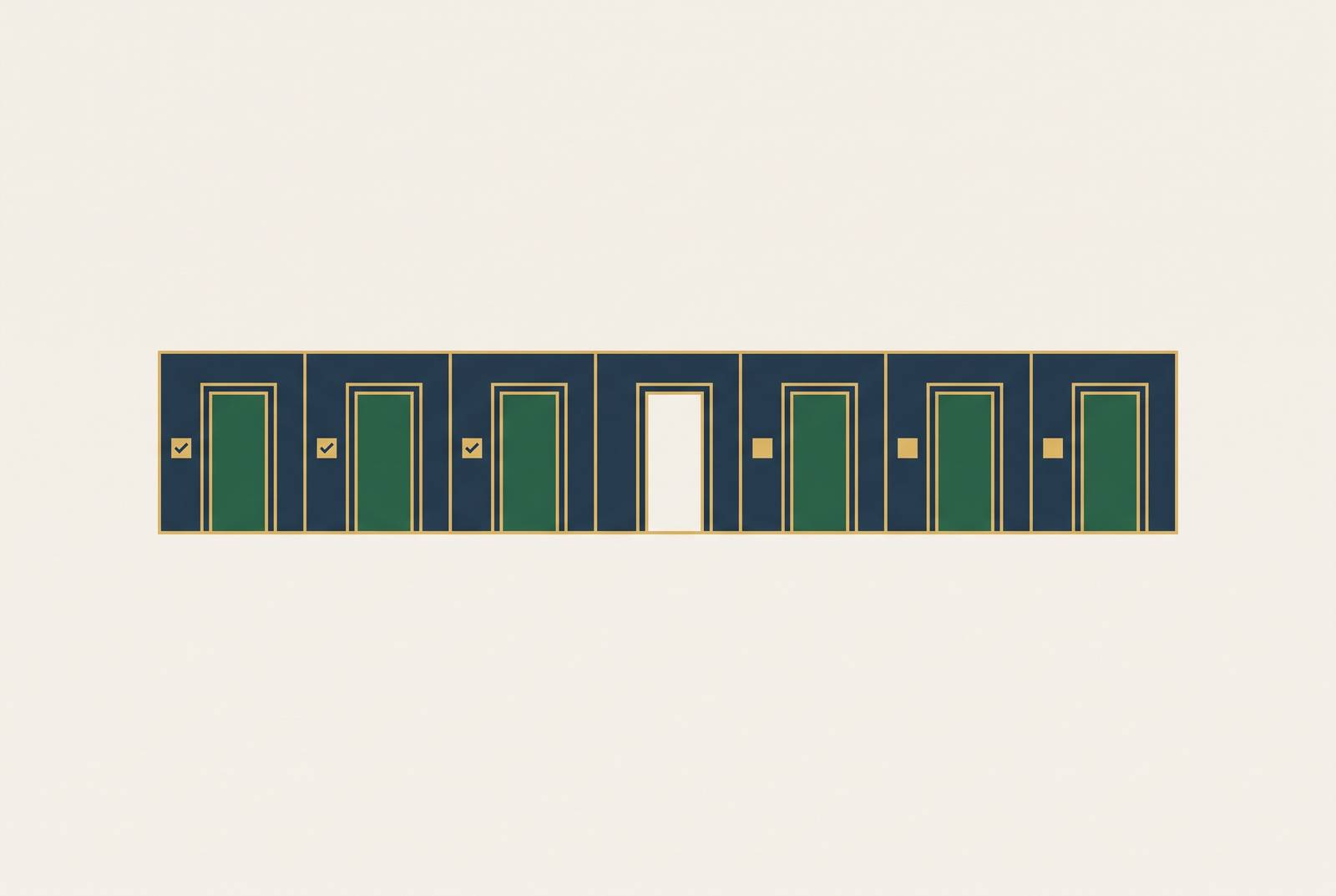
Division 8 takeoffs miss more openings than any other trade scope, and the misses aren't scattered at random. They cluster at six predictable points, and every one of them traces back to the same habit: an estimator working off a single document when the job actually calls for reading two or three side by side.
Division 8 covers everything that fills a hole in a wall, floor, or roof: doors, frames, windows, storefronts, curtain walls, and every piece of hardware that makes those assemblies function. Estimators who don't work this trade every day tend to underestimate how wide that scope runs, and hardware is where the underestimating turns expensive. A single opening can carry a hardware set with 15 or more line items: hinges, closers, locksets, thresholds, and more. Multiplying that across a 300-door project means the gap between a careful takeoff and a sloppy one runs into six figures before anyone notices.
The stakes go past dollars. A missed 90-minute fire rating on a stair door is a code violation, full stop. Missed electrified hardware turns into a cost problem only after award, once the 8-to-14-week lead times are already burning and there's no way to compress them. The fix is reading two or three documents against each other, every time, on every opening. It's reading two or three of them against each other, every time, on every opening.
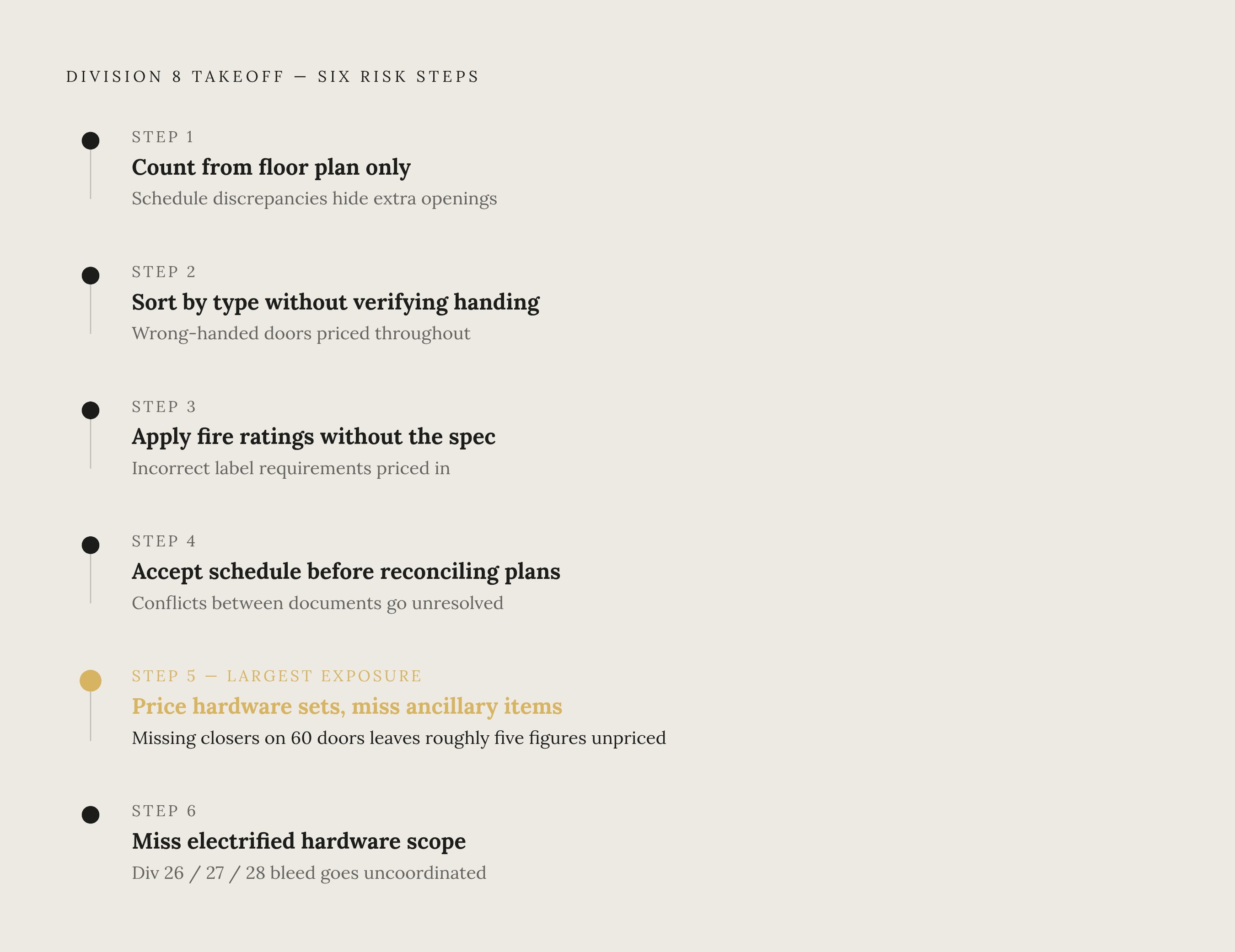
Step one risk: counting openings from the floor plan without checking the schedule
Counting openings is matching work, not measuring work. Every door, window, frame, and glazed opening has to get sorted by type and size before a single price attaches to anything.
The mistake most estimators make here is trusting the schedule on its own, and that trust is misplaced. Schedules go stale, get revised late, and pick up transcription errors from whoever built them. The right sequence runs the other direction: count straight off the plan first, then check that count against the schedule. A mismatch between the two is expected and normal. Skipping the comparison is the actual error, not the mismatch itself.
Two kinds of openings hide especially well here. Cased openings have no door and no hardware; they belong to the trim carpenter, not to Division 8, so counting them anyway just inflates the scope for nothing. Borrowed lites, the glazed interior windows set between two rooms, are Division 8 scope, but they sit buried inside wall types on the plan rather than called out on their own, so they get missed outright far more often than they get counted wrong. Reading the plan and the schedule side by side for both, not one after the other, catches this. A count built one document at a time looks complete on paper and falls apart in the field.
Step two risk: sorting openings by type and hardware set without verifying handing from the plan
Sorting each opening by door type (hollow metal, wood, aluminum), frame type, hardware set, and glazing type is what turns a raw count into something that can actually get priced. Rush this step and the estimator prices the wrong item against the right opening, and that error is harder to catch later than a missing opening ever is.
Matching each door to its hardware set, every hinge, closer, lockset, push and pull, and threshold, is where most hardware estimating mistakes actually happen. Handing sits inside that work as a specific trap. It doesn't change the opening count, but it changes the price, because levers, exit devices, closers, and strikes are all built for one hand or the other.
Read the swing arc straight off the floor plan. Don't take handing from the schedule's handing column. Schedules get typed up by hand from the drawings, and handing errors appear during transcription. The plan is the source of truth on which way a door swings. The schedule is a copy of somebody's interpretation of it.
Step three risk: applying fire ratings and code requirements without reading the spec simultaneously
Fire ratings, ADA clearances, life-safety codes, and acoustic ratings all live inside Division 8, and none of them are optional line items. They drive both cost and lead time, and they show up in places an estimator doesn't always expect to find them.
Smoke doors need self-closing devices, positive-latching hardware, and smoke gasketing. Many healthcare and education corridors require smoke-rated assemblies under NFPA 105, and that requirement rarely spells itself out in the schedule. It has to get pulled from the spec directly. NFPA 80 governs fire-rated door assemblies and, with certain exclusions, covers hinge selection, closing devices, latching hardware, glazing, gasketing, and annual inspection. A fire rating discovered missing after award stops being a pricing adjustment. It becomes a procurement crisis with a schedule attached to it.
Standards like ANSI/SDI A250.8 for standard steel doors and frames, HMMA 831 for hollow metal hardware locations, and DHI WDHS.3 for wood flush door hardware locations aren't background reading anyone can skim later. Each one is an opening-specific check that has to happen before pricing, not after.
Step four risk: reconciling the door schedule against the plans after the schedule has already been accepted as correct
The door schedule is a table listing every opening by mark, with size, material, core type, fire rating, and any special construction requirement attached. It looks authoritative because it's organized and complete-looking, and that appearance is why estimators lean on it more than they should.
Door schedules carry known reliability problems: missing hardware set numbers, wrong frame types listed, ratings that contradict each other, and late addenda that swap out hardware sets close to bid day. A few spots deserve a second look on every project. Watch schedule rows that looked fine before a revision landed but no longer match the current plan set. Watch electrified hardware, the category most often under-carried on a fast-turnaround bid. Watch pairs, rated openings, and special conditions like vestibules, ICU doors, and acoustic assemblies, all of which need more scrutiny than a standard single door.
Quality control at this step means a second person cross-checking the takeoff count against the schedule's stated total. If the schedule says 247 doors and the takeoff comes back off in either direction, that gap isn't a rounding issue. An opening got missed, or one got counted twice, and the job isn't done until someone finds out which one happened.
Step five risk: pricing hardware sets while missing ancillary items and divided-scope components
Most estimators price the door leaf, the frame, and the primary lockset because those parts are easy to see. Anchors, reinforcement, blocking, thresholds, gasketing, silencers, and coordinators on paired doors get missed because attention stays fixed on the visible parts.
Closers are the specific trap, and they sink more bids than bad unit pricing ever does. Missing the closer on 60 doors leaves roughly five figures unpriced. On electrified openings, a complete hardware set also needs fail state, power transfer, a door position switch, and a request-to-exit device, and those items often sit in a separate section of the hardware schedule, or don't appear on the schedule at all if the access control contractor is assumed to be carrying them.
That assumption is where the real risk lives. Items marked "by others," furnished by the access control contractor or by the owner, create scope that nobody quite owns. It's easy to drop that scope from the Division 8 takeoff when it actually belongs there, and just as easy to double it up when someone else has already priced it.
The electrified hardware gap: where Division 8 scope bleeds into Divisions 26, 27, and 28
Division 8 doesn't sit in isolation. It touches Division 5 for frames set into metal stud walls, Division 26 for electrified hardware, Division 27 for access control, and Division 28 for security. A missed coordination note between any of those divisions doesn't produce a pricing error. It produces missing scope, which is worse and harder to catch.
The gap tends to open in one specific spot: the hardware schedule calls for electrification on an opening, but the access control intent isn't fully drawn on the architectural set. Architects often standardize hardware sets across every paired door or vestibule opening on a project, while the security drawings mark readers only where access control is explicitly called for. An estimator reading the hardware schedule alone ends up pricing electrified prep on openings the access control contractor already carries, or missing it entirely on openings where both sides assumed the other side had it covered.
A complete electrified hardware set needs five things before that gap closes: fail state, power transfer method, door position switch, request-to-exit device, and power supply. Spell out the sequence of operation at that level of detail, and nobody in the field has to guess at what was intended.
The institutional layer: owner standards that override the project spec and add a separate reconciliation requirement
Institutional owners (state agencies, universities, health systems) issue their own hardware standards that override whatever the project spec says. These documents set mandatory product lists, keying systems, and finish requirements. They aren't optional supplements sitting alongside the spec, and pricing against the spec instead of the owner standard is a significant error that institutional estimators make.
The University of Texas at Austin's Design and Construction Standards for Door Hardware, Cornell University's Design and Construction Standards Section 087100, and the University of Southern California Health Sciences Campus guide specification Section 087111 all work this way. Michigan's DTMB Door Hardware Spec shows what full institutional compliance can demand: a detailed opening description and a hardware description with quantity, category, product number, fasteners, and finish, laid out under DHI Sequence and Format guidelines.
Price an institutional job straight off the project spec and skip the owner standard, and the count is likely to come out wrong. On these jobs, the owner standard controls product selection. The project spec does not, no matter how detailed the spec looks.
A Closed-Gap Checklist Across Six Steps
Every failure point above traces back to the same root cause: the estimator worked from one document when the job needed two or three read together. Fixing that takes a structural change to the process.
A checklist that actually closes the gap runs all six steps as one gate, not six separate ones. Count openings from the plan, check that count against the schedule, and run down every discrepancy before pricing starts. Tag borrowed lites and cased openings separately from standard doors to confirm what's actually inside the Division 8 scope boundary. Verify handing from the plan's swing arc, not the schedule column, and flag any mismatch as a likely transcription error. Confirm every fire rating and code requirement from the spec section itself, checking NFPA 80, NFPA 105, and ADA requirements opening by opening on every rated assembly.
Put a second reviewer on the schedule reconciliation, matching the takeoff count against the schedule's stated total and documenting every opening that doesn't match before the bid goes out. Audit every hardware set for the ancillary items (thresholds, gasketing, silencers, coordinators, closers) before pricing, and flag every electrified opening for fail-state and power-supply completeness. Read the Division 26, 27, and 28 drawings before locking in any opening with electrified hardware, and put the scope boundary in writing. On institutional work, pull the owner standard before pricing starts and confirm it overrides the project spec on product, keying, and finish.
The checklist works because it forces the cross-referencing to happen at each step instead of leaving it to memory. AI-assisted takeoff tools built for Division 8 can now run that cross-referencing across floor plans, door schedules, elevations, and 087100 specs at the same time, checking them against each other automatically instead of waiting for a second reviewer to catch what the first one missed. That's what turns a process that used to take days into one that runs in hours, and it's what turns this checklist from a wish list into something an estimator can actually enforce on every single bid.