Outsourcing Division 8 Estimating vs. Keeping It In-House
Catching errors requires reading four documents at once, not one after another.

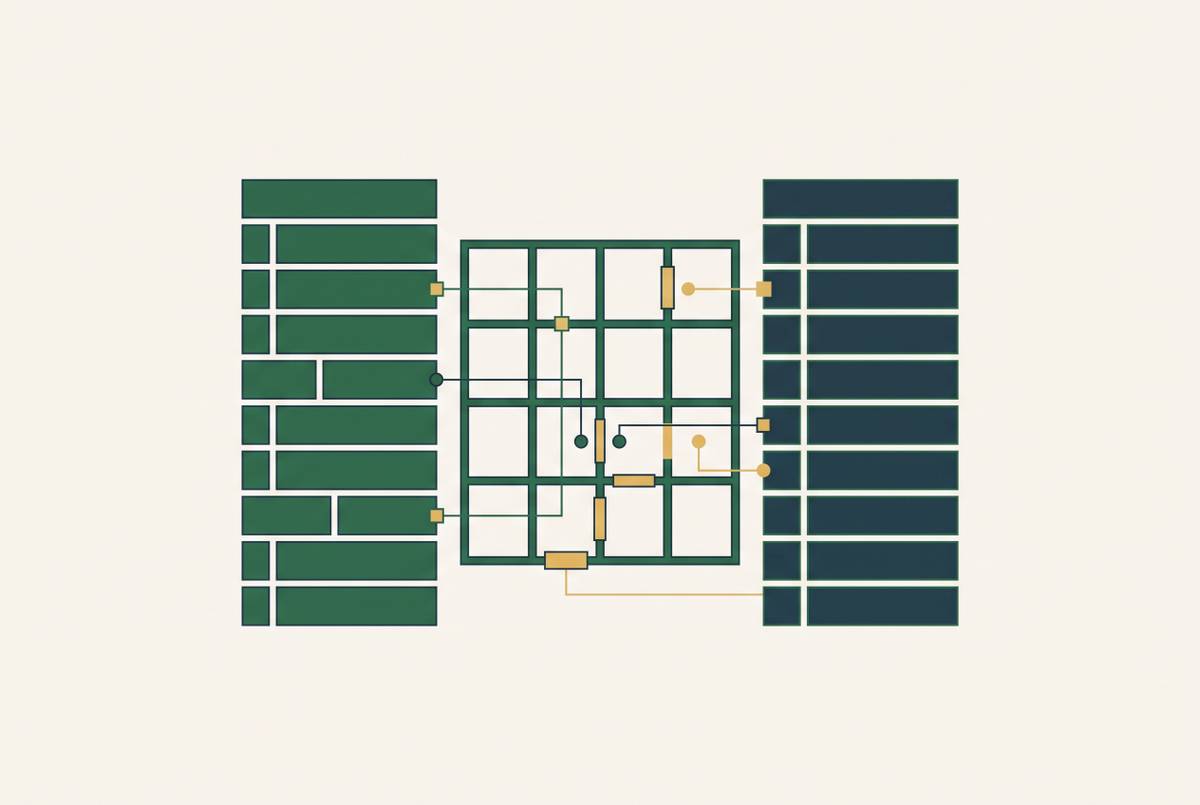
Catching a missing hardware set or an unrated door before a bid goes out comes down to one discipline: reconciling the door schedule, the 08 71 00 hardware spec, the floor plans, and the elevations at the same time, not one after another. Most rework traces back to a single cause: someone read these documents in sequence and missed where they contradicted each other. The fastest way to QC a door schedule is to check every opening against all four sources at once, by hand or with software built to do that cross-check automatically, before the estimate goes out the door.
Why Division 8 Estimating Is Harder to Delegate
Division 8 estimating doesn't get hard because there are too many line items to count. It gets hard because every opening is a small assembly problem, and solving it correctly means reading four different documents as one. A single door opening carries a leaf, a frame profile, glazing, a fire and smoke rating, a hardware set, a seal package, and installation labor, and each of those pieces comes from a different source: the architectural drawings, the door schedule, the hardware specification, and sometimes a separate partition schedule governing the wall type the opening sits in.
The door schedule does the connecting work. It assigns each opening an ID, a size, a material, a rating, and a hardware group number, and that hardware group number is the link back to the 08 71 00 spec section where the actual hardware set gets defined. Miss that link, or read the schedule without checking it against the spec, and the opening gets priced wrong, or worse, priced incomplete.
The errors that generate rework almost always come from this same root cause: someone read the documents one at a time instead of together. A leaf rating that doesn't match its frame rating. A pair of doors missing an astragal, or handed the wrong direction. A door labeled "S" for smoke that's missing its seal package. Electrified hardware specified on a schedule with no note about where the power or access-control wiring comes from. A threshold that fails ADA clearance because nobody checked the floor plan against the hardware spec in the same sitting. None of these are complicated errors to understand once they're found, but they're commonly missed, because catching them requires holding four documents in view simultaneously, not reading each one in isolation and trusting the paperwork to line up. That's the condition that makes the outsource-versus-in-house decision in Division 8 different from the same decision in a trade like drywall or concrete, where the quantities are the hard part and the documents mostly agree with each other by default.
What the outsource model actually requires to work for Division 8, not construction estimating in general
General construction estimating services that cover every CSI division offer real value, and that value holds for Division 8 contractors the same as it does for anyone else: it relieves the bottleneck that hits when several bids land at once, it turns a fixed estimator salary into a cost that only shows up per project, and it lets a contractor chase more simultaneous deadlines than one in-house hire could manage alone. DFE Estimating and Digital Estimating® are two examples of how this model runs in practice: pricing by project (with monthly retainer options available from DFE Estimating), fast turnaround, coverage across every division, and no software or staff cost sitting on the client's books.
None of that changes the fact that a Division 8 takeoff asks more of the outside team than a takeoff in most other divisions. It requires reading the door schedule, the 08 71 00 spec, the partition schedule, and the floor plan at the same time, and a generalist team that spreads its attention across every CSI division will work through that reconciliation slower, and with more mismatches slipping through, than a team that does nothing else all day. The outsourcing pitch at its strongest, that handing off the repeatable counting work frees up the in-house estimator to spend time on pricing and strategy, only holds up in Division 8 if the outside team's count can be trusted without a second pass. If the in-house estimator has to re-check the hardware groups and rating cascade anyway, outsourcing never actually saves any time.
That makes due diligence the real variable before hiring any outside partner for this trade. Ask whether the team can show familiarity with door schedule formats as they actually appear on real projects, whether they understand hardware group logic well enough to catch a mismatch between schedule and spec, whether they know how fire ratings cascade differently depending on opening type, and whether they can separate what a project spec says from what an owner's standing institutional requirements demand on top of it. None of this is an argument against outsourcing Division 8 work. It's the same "outsource the takeoff, keep the pricing" logic that applies in any trade, applied with a higher bar, because the takeoff itself carries more risk of hidden error. An outside partner's output is worth paying for only if that team understands the same document logic that purpose-built Division 8 software like Fresco is designed around: the gap between spec language and owner standard, the way a fire rating has to hold across leaf, frame, and glazing together, and the hardware group number that ties the schedule to the spec section in one motion.
What the in-house model actually requires to work, and where it breaks down under bid volume
In-house Division 8 estimating carries a weakness that often doesn't get named until a contractor has already lost work to it: the whole operation scales only as far as one person's working hours. That ceiling decides how many bids a contractor can realistically take on, and how many bids go out the door matters more for revenue than how precisely any single one gets priced. A contractor who bids on more jobs at a reasonable level of accuracy will fill a backlog faster than one who bids fewer jobs with marginally sharper numbers on each. When the estimator is maxed out, the cost doesn't appear as a line on a financial statement. Instead it appears in invitations to bid that get turned down quietly, which makes the real size of the problem easy to miss until someone adds it up.
Digital Estimating® puts a number on the fixed side of this equation: hiring a full-time estimator runs over $95,000 a year before any software licenses get added on top. That fixed cost sits on the books whether the pipeline is full or running thin, which is the core financial case for at least some outsourcing when bid volume swings up and down through the year.
What in-house keeps, and what outsourcing can't easily replace, is memory. A dedicated Division 8 estimator builds up knowledge over time, of which owners run recurring hardware standards, which suppliers get approved fastest, which project types tend to carry which complications, and none of that lives in a spec document anywhere. An outside team starts from zero on every single job. That advantage matters most on institutional work, where an owner's standing hardware requirements go well beyond anything written into the project spec itself, a point worth developing on its own. When bid volume climbs past what one estimator can carry, the answer isn't necessarily a second hire or a handoff to an outside firm. In-house teams that bring in AI-powered Division 8 takeoff tools can hold onto that institutional memory and keep pricing authority in-house while cutting a count down from hours to minutes, which raises how many bids one estimator can chase without adding headcount.
How Institutional Owner Standards Change the Difficulty Calculation
Institutional work raises the stakes on Division 8 estimating in a way few other building trades deal with, because large owners often run hardware standards that apply across every project they build, not just whatever happens to be written into one project's spec. Someone has to hold that knowledge, whether the takeoff gets done in-house or sent out, because it won't appear automatically on the drawings.
Cornell University's standard requires the hardware schedule to be prepared by, or under the direct supervision of, the hardware supplier, coordinated against the doors, frames, and related work so that size, thickness, hand, function, and finish all check out, and the schedule itself has to detail the fabrication and assembly of the hardware along with supporting procedures and diagrams. The University of Southern California's Health Sciences Campus spec, Section 087111, goes further still: suppliers have to be pre-approved, specific basis-of-design products get named outright, and the supplier is on the hook for a qualified consultant available throughout the work to coordinate with the contractor, architect, and university on hardware and keying, plus warehousing located near the project itself. A state agency's facility-standards specification, dated April 2025, requires every hardware submittal to open with a preface sheet listing both the manufacturer named in the spec and the manufacturer actually being scheduled, item by item, and requires that hardware on fire-rated openings comply with NFPA 80 and carry UL testing and listing matched to the door types and sizes called for.
An outside estimating team with no history on a given institution has to reconstruct all of this from scratch on every single bid, while an in-house estimator, or a distributor rep, who's worked that owner before carries much of it as background knowledge already. Instead, the onboarding cost for an outside partner runs higher on institutional work, and the in-house review of anything an outside team produces has to run more thorough, eating into whatever time savings outsourcing was supposed to deliver. The knowledge burden is real either way. It's just a question of where it has to sit.
Where AI-assisted takeoff changes what each path can deliver
AI tools built specifically for Division 8 takeoff change what each side of the outsource-versus-in-house decision can actually deliver. For in-house estimators, the effect is bigger than for outsourcing, because what these tools attack directly is the time it takes to reconcile documents, not the question of who's on payroll.
That's the exact problem this whole trade runs into: reading door schedules, hardware specs, partition schedules, and floor plans all at once to catch mismatches in configuration, swing, hardware set, and material before they turn into rework. One concrete feature with real consequence on both sides of the decision is diff-tracking across construction-document milestones, which displays every opening added or dropped as a clean comparison against the prior drawing set. That cuts the risk of missing something at addendum, and it cuts the hours an in-house estimator would otherwise spend re-checking a count by hand every time the drawings get revised.
For an in-house team, the practical effect is that one estimator with the right tooling can carry a bid volume that used to require either a second hire or help from an outside firm. The hours needed per bid go down, so the number of bids that estimator can take on in a month goes up. Fresco is one example built around exactly this problem: it reads door schedules, elevations, floor plans, and hardware specs at the same time, rather than one after another, to automate the reconciliation work that causes most of the errors described earlier in this piece. It's built around Division 8's document logic specifically, not adapted from a tool meant to cover every CSI division at once.
There's a real limit to what any of this software does. None of it handles scope interpretation: whether a given opening needs a hardware allowance, a particular fire rating, or a special frame buried in a spec section three pages removed from where anyone would expect to find it is still a judgment call, and that judgment still belongs to the estimator. AI tooling isn't a third path that makes the outsource-versus-in-house decision beside the point. It raises what in-house teams can deliver without hiring anyone new, and it's a capability any Division 8-specific outsource partner should be expected to use as well. A general-purpose takeoff tool stretched to cover this trade will fall short of a system built around its specific documents and the logic connecting them, no matter how capable that general tool is elsewhere.
The decision framework: which path fits which situation
The choice between outsourcing and keeping Division 8 estimating in-house isn't mainly about cost. It comes down to where the work of reconciling documents and the knowledge of owner standards need to sit, given a contractor's project mix, how many bids come in, and where the business is headed.
Outsourcing, or a hybrid arrangement, tends to fit a contractor whose bid volume swings widely across the year, since fixed in-house overhead costs more relative to the work it produces when the pipeline runs thin for stretches at a time. It also fits a contractor whose project mix runs mostly plan-and-spec commercial work without a layer of persistent owner standards sitting on top of the spec, since a capable outside team can reconcile documents from a cold start without paying a steep knowledge premium to do it. A contractor still growing toward the volume that justifies a full-time Division 8 estimator can treat outsourcing as the entire estimating department for the time being, until that threshold gets reached. And where the in-house estimator is a senior person whose time is worth more spent on pricing, client relationships, and bid strategy, handing the takeoff itself to an outside partner is simply the right division of labor.
Keeping the work in-house, or building toward that, fits a contractor whose project mix leans heavily institutional, where the accumulated knowledge of a recurring owner's hardware standards and approved vendor list amounts to a real edge over competitors starting from scratch each time. It fits a contractor whose bid volume runs high and steady enough that the fixed cost of an in-house estimator ends up lower per bid than paying outsourced rates project by project. And it fits a contractor whose edge in the market is speed of response and bid accuracy, advantages that compound once an estimator knows an owner's standards cold.
For a lot of mid-size contractors, the practical answer lands somewhere between the two: an in-house estimator handles the institutional and relationship-sensitive work where memory of an owner's standards pays off, while outsourced or AI-automated takeoff covers the higher-volume plan-and-spec commercial work that doesn't carry that same knowledge premium. Whichever path a contractor builds toward, one thing doesn't move: pricing authority and scope judgment stay in-house no matter who runs the takeoff. The counting can be delegated. The estimate can't be. And whether that counting gets done by an in-house hire, an outside partner, or software, the tool or team doing it has to be built around Division 8's own document logic, the schedule, the spec, the plans, and the hardware set read together, not a general workflow stretched to cover a trade it was never built for.