Allowance vs. Specified Hardware Sets in Division 8 Bid Strategy
Choosing between them determines who bears cost risk when hardware selections change.

Pricing a Division 8 opening comes down to one of two methods: price it against a fully specified hardware set, or carry a per-leaf allowance when the documents won't support a set. The choice determines who absorbs cost risk if the final hardware selection differs from what was priced, which project types will even accept the method, and how much reconciliation work has to happen before a number goes out the door. If you get this decision wrong, a bid that looked competitive at submission turns into a margin problem during construction.
Allowance and Specified Hardware Sets in a Division 8 Bid
Every Division 8 bid rests on one of these two pricing structures, and picking one is not a matter of preference but a commitment that shapes how the rest of the project unfolds.
A specified hardware set, also called a hardware group, is a numbered list covering every component needed for a given door type: hinges, lockset, closer, stop, seals, threshold, silencers, and any specialty items the opening requires. These groups get labeled sequentially, HW-1, HW-2, HW-3, and the door schedule on the architectural drawings references them directly. Every door assigned to a given group gets identical hardware. The hardware consultant who builds these groups works from door function, location, fire rating, accessibility needs, security level, and expected traffic, and once the specification is issued, it becomes the contractual basis for the hardware package. Any deviation from it requires formal approval through the submittal process. Part 2 of the specification section is where the real product definitions live: door gauge, core type, hardware grade, acceptable manufacturers, and the product standards the hardware has to meet. This is the section an estimator reads closely when preparing a submittal, because it states what the project actually requires rather than what a typical project of this kind usually needs.
An allowance works differently. It's a per-leaf dollar figure that stands in for a specified set when the governing documents don't give the estimator enough to price against. Estimators commonly carry a per-leaf door hardware allowance instead of pricing a set when bidding information is incomplete or the scope of work isn't fully defined. An allowance is a fallback position, not a preferred strategy, and a competent bid that uses one will spell out what the allowance figure actually covers: manufacturer's standard closers, panics, and pulls, typically, while excluding specialty items like card readers, custom pulls, and power-assist operators.
Both of these appear as a single line item on a bid form, and at first glance they can look interchangeable, but they are not. One locks in a defined scope before the bid goes out. The other defers that definition to later in the project, and that difference in timing is what the rest of this piece is about.
Where Each Approach Puts the Financial Risk
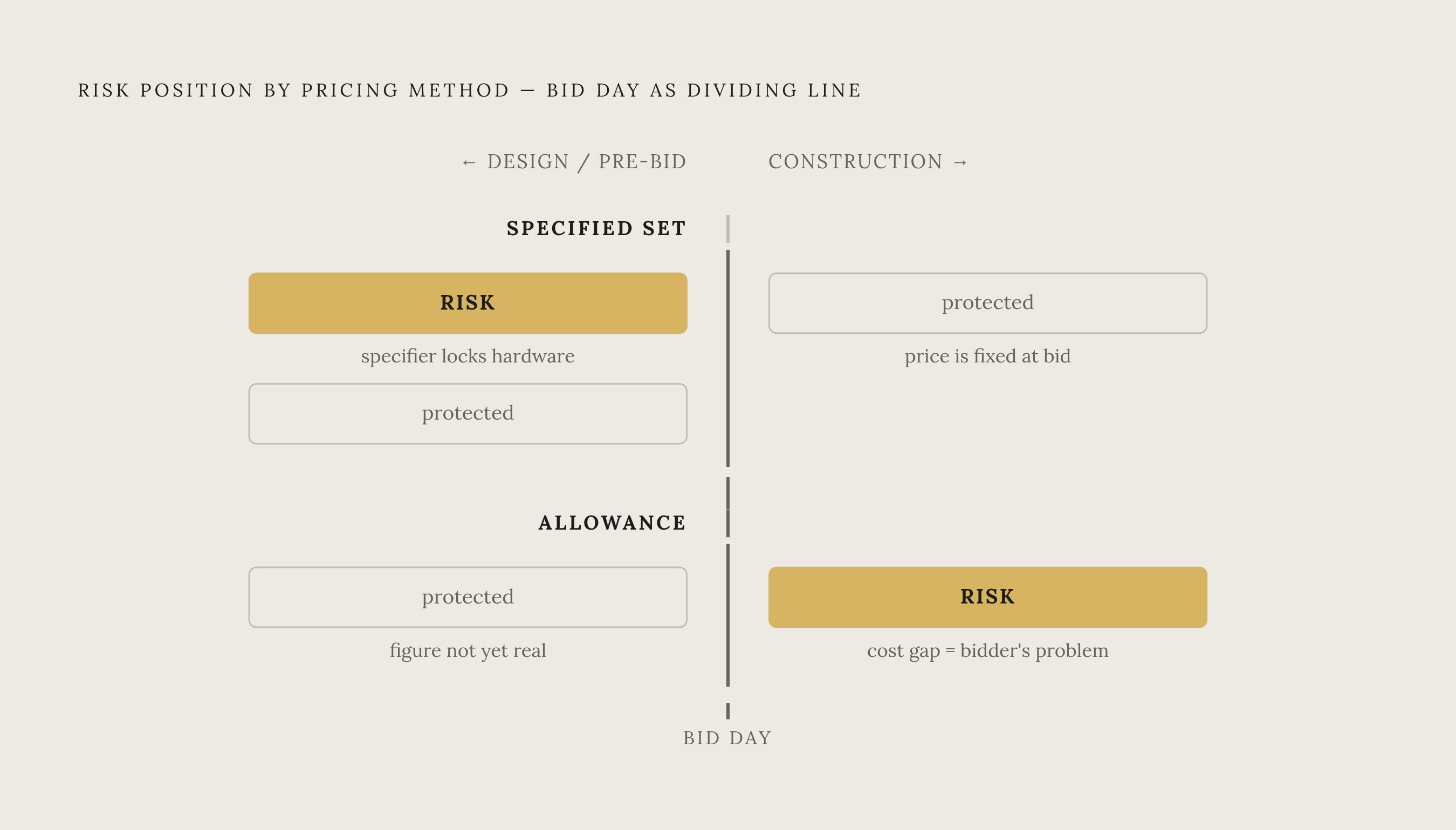
The real difference between an allowance and a specified set is who holds the financial risk once the project moves past bid day, not document completeness, and that assignment is close to permanent once the bid has been submitted.
With a specified set, the risk sits upstream, with the specifier and the documents. If you write a hardware set correctly and cross-reference it against the door schedule, you head off costly change orders and keep the project on the right side of code compliance, so the cost of getting the specification wrong falls on the design side before a bidder ever sees the package. For the bidder, a specified set functions as a constraint: it tells the estimator what to price, which limits the room for creative cost engineering but also limits the odds of an unpleasant surprise six months into the job. Products that were never specified, and that haven't been approved as alternates, can't be substituted in the field without a formal substitution request and architect sign-off. The boundary is fixed, and both sides know where it sits.
An allowance moves that risk downstream, onto the bidder, and the risk only grows as the project moves forward. The moment the owner or architect actually selects the hardware, any gap between the allowance figure and the real cost of that product becomes a negotiation over a change order, or, if the negotiation doesn't go the contractor's way, a straight loss of margin. Warranty terms carry the same exposure: comparing the hardware product warranties against what the specification requires is part of basic diligence, and where a gap shows up, the limits of those warranties need to be spelled out in the bid proposal, because an allowance makes no promise about warranty coverage on its own. Scope boundaries carry the same risk. Items excluded at bid time, card readers, power-assist operators, custom pulls, can turn into contested scope once construction is underway and someone has to decide who was supposed to supply them.
The asymmetry is the whole point. An allowance protects the bidder at the moment of submission and exposes the bidder afterward. A specified set does the opposite: it limits the bidder's options at submission but protects margin once the work starts. Neither approach eliminates risk. Each one places it at a different point in the project timeline.
Why document completeness is the actual driver of which approach is viable
An estimator does not choose between these two methods in a vacuum. The documents in hand at bid time make the decision for them.
If a project is fully specified, an estimator has what's needed to price against sets directly. The door schedule is the bridge between the architectural drawings and the hardware specification, and when both documents are complete and agree with each other, an estimator can cross-reference them opening by opening and price each door against its assigned group with confidence.
Incomplete documents break that cross-reference, or make it unreliable. A door schedule might call for a hollow metal frame and a labeled door, but the hardware set assigned to it can introduce a closer, a panic device, a lock function, or an electrified preparation that shows up nowhere else in the package. When one document contradicts another, the estimator has three choices: carry an assumption, qualify the submission, or go back and ask for clarification. None of these are free, and inconsistencies between the door schedule and the hardware specification are a common source of delays and change orders once a project is under construction. Two specific failure patterns occur during this kind of review. A door gets assigned to two different hardware groups across two different documents, and the estimator has to decide which one governs. Or a door gets assigned to a hardware group that does not exist anywhere in the hardware specification, so the door count is accurate but the hardware behind that count is missing.
Electrified openings make this worse, because they turn a document problem into a coordination problem that spans three trades. Electrical drawings might show power supplies without showing the raceways that connect them, or they might identify the wiring without saying who has to supply the device it feeds. A functioning scope matrix has to record who supplies, who installs, who wires, who tests, who commissions, and who warranties each individual component. Card readers, electrified locks, electric strikes, magnetic locks, power transfers, request-to-exit devices, door-position switches, and power supplies all need this kind of explicit assignment, and a bid team has to confirm supply, wiring pathways, controls, testing, and commissioning responsibility so nothing falls into the space between Division 8, Division 26, and Division 28.
The threshold for which method to use comes down to whether the documents support opening-by-opening review: cross-referencing floor plans, wall types, reflected ceiling plans, room data sheets, life-safety drawings, finish schedules, hardware sets, specifications, addenda, and consultant sketches, all at once, against each other. When you can do that review, specified-set pricing is the right call. When it isn't, an allowance with clearly stated exclusions is the only position an estimator can defend. Holding that many documents against each other at the same time is difficult to do by hand, which is the specific kind of problem that AI-powered platforms like Fresco are built to address: pulling the door schedule, the plans, and the hardware specification together and flagging where they disagree before an estimator has committed to a number.
Project Type and the Stakes of Each Approach
Document completeness is not the only thing that decides whether an allowance is usable. Some project types rule it out regardless of how complete the documents are, and institutional work shows this most clearly.
Rutgers University's design standards state outright that you need to develop hardware sets for each unique condition for the building, so allowance-based pricing is closed off entirely for any product category tied to campus security. The University of Alabama's guidelines go further on a specific product: they specify Sargent cylinders with no substitution permitted, require the keying system to match the existing Sargent restricted keyway, and prohibit distributor keying, conditions an allowance figure cannot satisfy because it makes no commitment to a manufacturer. The University of Houston's master specification requires an Architectural Hardware Consultant who also holds Electrified Hardware Consultant credentials, and it lays out specific access control workflows and names particular brands for keying. That's owner-standard procurement with zero room for allowance-based substitution. Cornell University requires extended special warranty periods for mortise locks and latches, and a shorter but still elevated warranty period for exit hardware, and a per-leaf allowance can't reliably back these commitments because it makes no promise about either manufacturer or hardware grade. Four different institutions, four different specific requirements, and the same underlying result: the owner's standards decide the method before the estimator opens a single drawing.
Healthcare work applies similar pressure through function. Operating room doors need hands-free operation, typically through power operators triggered by elbow-height push plates or ceiling-mounted motion sensors, and that level of functional precision can't be captured in a dollar-per-leaf figure. The requirement is a specific mechanism, not a price point, so it has to be priced as a specified product.
Fire-rated assemblies apply the same discipline, no matter the project type, institutional or not. A labeled door by itself doesn't satisfy the requirement. The door, frame, glazing, hardware, and closing and latching functions all have to work together to meet the rated opening's performance, and an allowance can't commit to that alignment because it isn't tied to a tested assembly. Only hardware that UL has tested and listed for the specific door types and sizes required is acceptable, and the allowance figure carries no such guarantee on its own.
Competitive commercial work with complete documents runs in the opposite direction. On larger public bids, most architects will accept competing brands that meet the specification's requirements, and a bidder who understands where those voluntary alternates exist can cut cost without weakening the opening's performance. Spotting that opportunity is part of what a well-prepared Division 8 bidder brings to a job, and it only works against a specified set. An allowance has no fixed baseline to engineer savings against, so this entire category of margin opportunity closes once a bidder falls back to a per-leaf figure.
How fast you can bid it
Allowance pricing gets a number out the door faster, but it hands the reconciliation work to the bidder instead of doing it up front, so the time saved at submission tends to come back later, usually with interest, during procurement and construction.
Pricing a specified set properly means reconciling the full document package before a number can be issued. A sound review starts at the door schedule and works outward through everything that bears on each opening: floor plans, wall types, reflected ceiling plans, room data sheets, life-safety drawings, finish schedules, hardware sets, the specifications themselves, addenda, and consultant sketches. That process surfaces openings that appear in one document but not another, along with conflicts in handing, door size, labeling, fire rating, and hardware function, conflicts the estimator has to resolve or flag before pricing anything. Pricing door types in isolation, without connecting each one to its actual location and use, is how these conditions get missed. An opening-by-opening review catches them because it ties the product to the specific door it's going on.
An allowance defers this reconciliation instead of eliminating it, and the work doesn't disappear just because it happens later. MDH gets the best result on a project when you bring it in at or before the bid stage, because there's still time to review the specification, flag issues or opportunities, and help put together a bid that's both accurate and complete. Projects where a hardware supplier is brought in only after award, once material is already needed in the field, are consistently the projects where schedule pressure and specification mismatches cause the most friction. When documents are fragmented or arrive incomplete, cross-referencing the door schedule against elevations and the specification by hand is where mistakes enter the process; automated Division 8 takeoff software is built to remove that friction point by pulling all three document types together and surfacing the inconsistencies before the bid is locked in. A gap discovered after award doesn't stay contained to hardware cost. It reaches into procurement timing, submittal review, installation sequencing, and the question of which trade was responsible for a given component in the first place, and every one of those is more expensive to sort out under schedule pressure than it would have been at bid time.