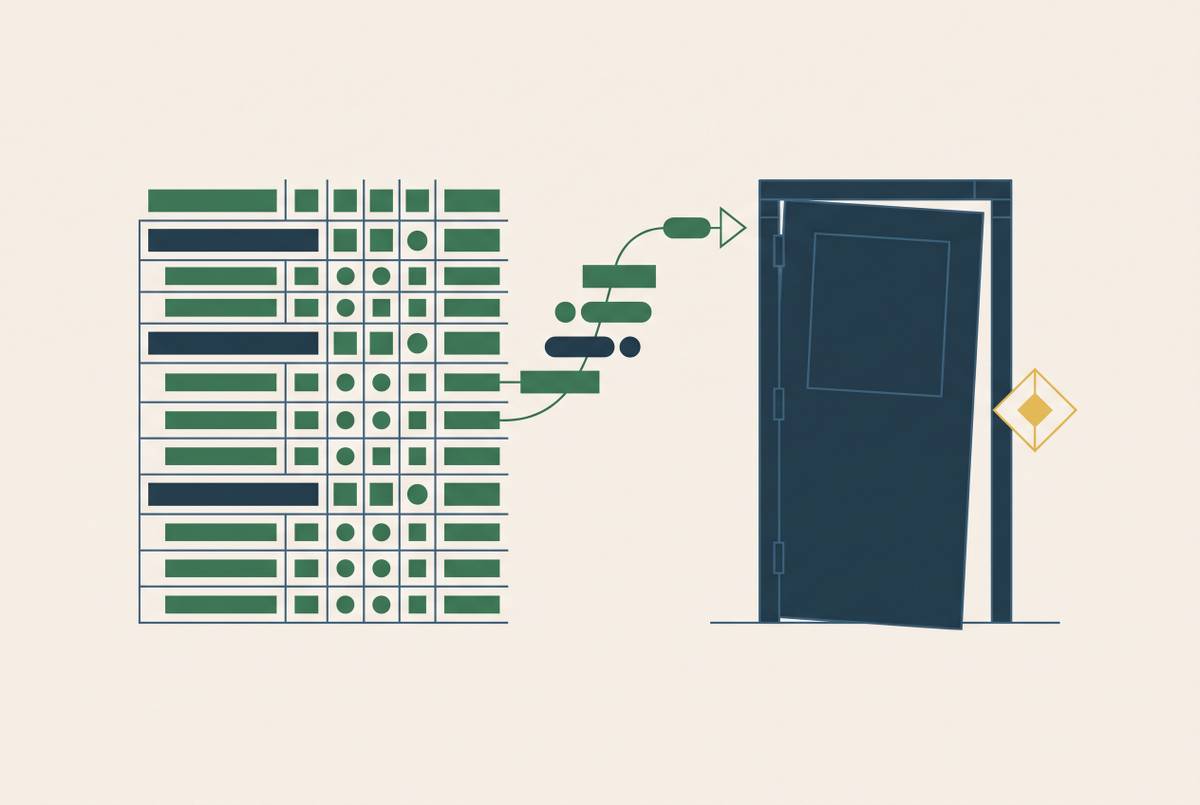
Software That Cross-Checks Door Schedules Against Architectural Drawings and Division 8 Specs Simultaneously
This software reconciles conflicting door requirements scattered across multiple project documents.

Software that cross-checks door schedules against architectural drawings and Division 8 specs simultaneously reconciles those documents. It compares each opening across the documents, fills missing information, and exposes conflicting hardware assignments and frame requirements.
Why Division 8 bids fail between documents, not inside them
An estimator finishes the door schedule, records every opening and hardware group, and believes the takeoff is complete. The schedule has yielded a populated list. Yet that list does not establish whether the assigned hardware exists in the specification or fits the opening shown on the drawings. Finishing the schedule is where reconciliation begins.
The gap lies between the documents themselves. The schedule identifies openings and assigns hardware groups, while floor plans show location, handing, and context. The 087100 spec says what is in each hardware set. A group number can be transcribed correctly from the schedule yet disagree with the specification, including a set captioned “(NOT IN USE)”. Nothing about the accuracy of the transcription resolves that disagreement.
A defensible bid therefore depends on more than complete extraction. It depends on matching the opening to its requirements across the document set. An estimator can read every schedule row correctly and still need more information to price the package.
What a Division 8 document set actually contains and why reading it sequentially guarantees gaps
A full Division 8 takeoff needs at least five types of documents, and an owner standard that applies to the work adds a sixth. These are the door schedule, hardware specification in Section 08 71 00, door elevations, partition schedule, and floor plans. Each supplies a different part of the opening. An owner standard can then supplement or supersede requirements in the project specification.
The schedule normally provides the opening ID, size, material, frame type, fire rating, and hardware group assignment. However, handing, leaf count, wall type, STC, and existing-frame status are frequently blank. Information for those blank fields can be located elsewhere in the set, beyond the document being extracted.
For a single opening with missing schedule fields, handing comes from the push-side plan view. Leaf count comes from the elevation, where a pair shows two drawn leaves. The partition tag at the opening leads to the partition schedule, which supplies the stud information and throat size that estimators call jamb depth. The hardware specification lists the set contents, finish codes, and OT designations and says whether the set is live or retired. Filling in that schedule row takes four other documents.
A frame type recorded from the schedule still has to be reconciled with the opening shown on the plan, the elevation, and the wall information required at ordering time. Likewise, a hardware group number remains only an assignment until it is matched to the specification. Sequential extraction creates the pieces, but not the comparison.
The two hardware-set conflict types that a schedule-only read cannot catch
A door has a dual-set assignment when the schedule gives it one hardware group number and the specification gives it another. Either number can look right on its own. The conflict appears only when both assignments are compared against the same opening ID. The estimator must then decide which document governs before pricing the hardware.
Phantom set assignment is a different failure. A schedule assigns a door to a set number that does not appear in the hardware specification. The row looks complete because its hardware field is populated, but there is no corresponding set definition to extract.
A Santa Fe project spec had four doors simultaneously assigned to two hardware sets and nine doors assigned to a set captioned “(NOT IN USE)”. The first condition illustrates competing assignments. The second shows why finding a set number in the specification is insufficient unless the check also establishes that the set is live.
The hardware set defines what mounts on the door, while the schedule defines the preps with which the frame must be factory-ordered. Those requirements must align exactly. A tool that extracts the hardware and frame information separately has not yet tested whether the frame will have the cutouts the hardware needs.
How owner standards add a layer of conflict that project-spec-only tools cannot see
Universities, hospital systems, and government agencies publish standing standards that can specify preferred or mandatory manufacturers and products, sometimes with no-substitution language. Where applicable, these standards supplement or supersede the project spec. A project-only review cannot reveal a conflict with a document it never reads.
Cooper University Hospital’s Construction Project Design Standards set out the specifications for emergency release hardware and medical grade door stop under Division 08/Door Hardware (087100). The NYS Office of Mental Health 36th Edition, dated July 2026, provides recommended guidelines for psychiatric settings, including ligature-resistance tolerances, electrified hardware risk factors, and manufacturer commissioning of locksets after installation. These requirements have different scopes and statuses.
University of Texas at Austin Design and Construction Standards guide the architects, engineers, and contractors who work on campus. Their Division 08 Door Hardware section has sub-section 08.08.00, Commissioning of Openings, which was updated in December 2025. The applicable standing document has to enter the comparison.
The project drawings, the project spec, and the owner standard all have to be checked against each other. A package can otherwise be wrong on manufacturer, model, or finish before any individual opening is mispriced. If electrified hardware is missing, an incomplete hardware allowance can also leave gaps in the access control and low-voltage scope. Institutional work further includes authoring hardware sets that conform to the owner standard, rather than simply extracting sets already written into the project spec.
Why the document-by-document approach is a structural problem, not a speed problem
A schedule-first process records hardware assignments as given. During that pass, the assignments are not being tested against the specification. A later spec-reading pass extracts hardware definitions, but extracting those definitions does not automatically revisit every schedule row. That comparison is a separate operation.
More careful reading does not substitute for reconciliation. An estimator can perform it manually, but doing so requires bringing the relevant information back together for every opening. Competitive bid windows constrain that additional work. When a full day goes into reconciling one hardware set against one schedule, that effort also limits the number of other bids the estimator can pursue.
The distinction is therefore not simply faster versus slower. It is whether the workflow makes conflicting requirements visible. Accelerating a document-by-document extraction process can produce the same unresolved assignments sooner, without establishing whether they agree. The structural change occurs when the workflow compares the sources, rather than treating completion of each source as completion of the takeoff.
That distinction also defines what “simultaneous” must mean in practice. Merely opening several documents does not reconcile them. Their requirements must be held against the same opening so that an omission or contradiction in one source can be exposed by another.
How software checks door schedules against drawings and Division 8 specs at the same time
A simultaneous check processes the schedule row with the related plan, elevation, and specification information available for comparison. If handing is blank, it reads the floor plan. If leaf count is missing, it reads the elevation. Wall information comes through the partition reference, so the completed row draws from the documents that actually contain the required information.
The same check compares hardware assignments with the spec. It flags an opening that has different group assignments and checks each assignment in the schedule against the live set list. This distinguishes a defined set from an absent or retired one. It also exposes prep conflicts where the hardware requirements and frame preparation do not align.
Plan-to-schedule reconciliation works in both directions. It detects doors drawn on plans but absent from the schedule, scheduled doors with no plan location, and doors appearing more times on plans than in the schedule. For an unmatched door code, the output can place the estimator at the relevant location on the plan. That turns a search problem into a specific place to review.
Reading across documents also helps with the first decision on whether to bid. A recap can assemble opening count, hardware set count, project type, key system, access control, STC, lead-lining, approved manufacturers, and substitution status from the spec, schedule, and plans. Detailed review then concentrates on the non-conforming pieces rather than reconstructing the straightforward portion. The software exposes the disagreement, but which document governs remains a human decision.
How the three tiers of Division 8 software differ in what problem they actually solve
The first tier has tools that count openings. They answer how many doors or opening symbols appear in the material they read. That is a useful quantity task. However, a tool that does not read the hardware specification has no mechanism to establish whether the assigned hardware matches the specification. An accurate opening count is not evidence of a reconciled hardware package.
The second tier addresses cross-document reconciliation. These tools compare information from schedules, drawings, and specifications. This is where hardware assignment checks and missing-field completion become possible. The depth of conflict detection varies, and the logic is not always publicly documented, so membership in this tier does not establish every capability.
The third tier has quoting systems for distributors. TRUE is a cloud-based platform for door hardware suppliers that handles CRM, quotes, contracts, resource schedules, inventory, invoices, job cost accounting, and reporting. These functions help price and manage a package once it has been defined. They operate after the source documents have been checked for agreement.
Tier selection is therefore separate from product quality. A count can be accurate while the hardware package attached to it remains unresolved, and a quoting system can manage that package without establishing its source-document consistency. The buyer should first establish what question the Division 8 software needs to answer.
What to look for in a tool built for cross-document reconciliation
For estimators and distributors assessing tools, the evaluation should test reconciliation on a real document set with a conflict. A clean-package demonstration proves too little. Test whether the tool exposes a disagreement that cannot be found by reading the schedule alone. A demo that only produces counts and populated rows has not demonstrated that operation.
Does the tool derive handing, leaf count, and wall type from other documents when the schedule omits them? The hardware test should then distinguish dual-set assignments, phantom sets, and retired sets rather than treating any populated group number as valid. Plan reconciliation should expose both unscheduled doors and scheduled doors without a plan location. Prep coordination should reveal a mismatch between the hardware definition and the frame preparation requirements.
The evaluation should also examine the reasoning and output. Recognizing geometry is different from understanding a hardware set and its relationship to the 087100 spec, schedule, and floor plans. The tool should return the straightforward portion assembled, with a short, specific list of conflicts requiring an estimator’s decision. A long warning list that requires as much interpretation as manual reconciliation does not demonstrate the intended workflow.
Institutional work needs one more check against the owner standard that applies. The tool should read both documents and compare that standard with the project spec to show where their requirements conflict. The final question concerns authoring as well as reading. Can the tool build hardware sets against the owner standard, rather than only reproduce what the project spec already states?