Why Door Schedule Omissions Survive Manual Review and Which Software Finally Catches Them
Missing hardware definitions hide in document links even when opening counts match.

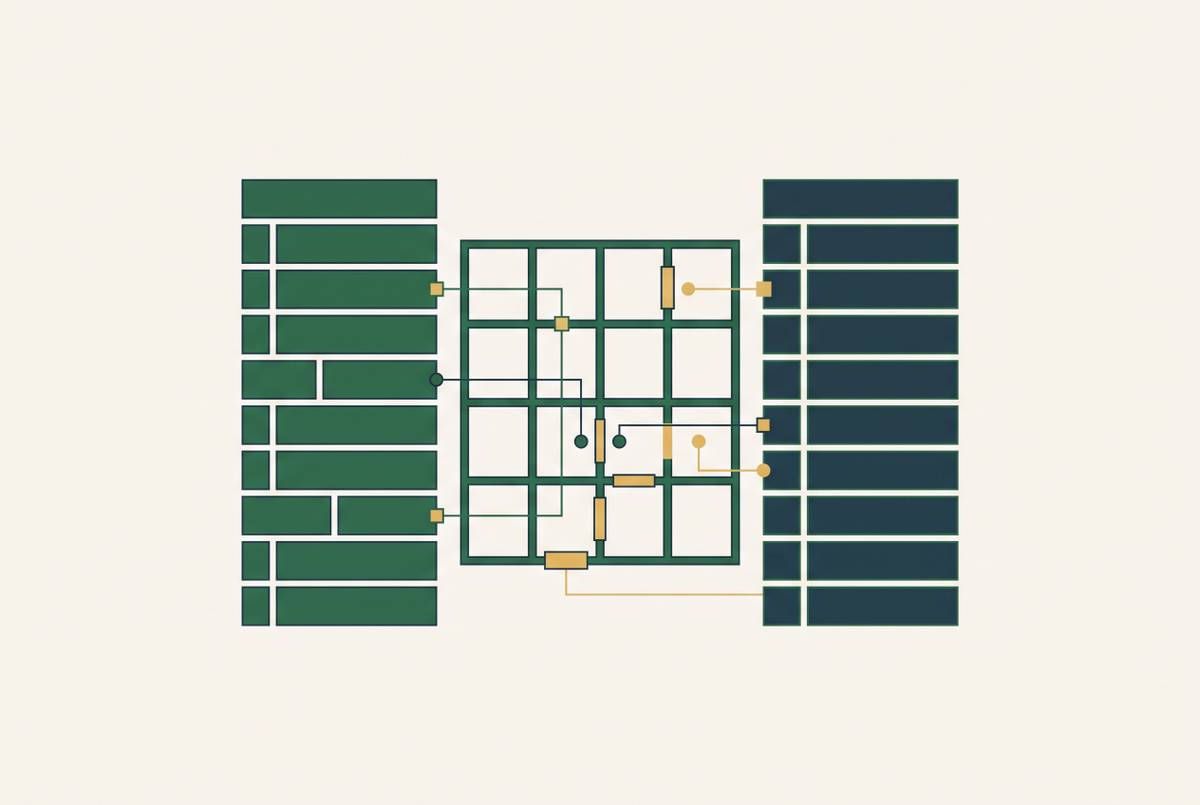
Catching door schedule omissions before bid submission requires opening-by-opening reconciliation. The software category built for this work reads the door schedule, floor plans, elevations, partition information, and hardware specification together. The software helps with more than speed because missing hardware definitions and conflicting set assignments can hide in the links between documents even when the opening count is right.
Why a single opening takes five documents to verify
An estimator has the door schedule open, with a row showing the door number, size, material, fire rating, glazing requirements, and hardware group. The row appears ready to price against. Yet the hardware group number points somewhere else, to a definition in the specification. Reading HW-1 identifies an assignment, but it does not establish what that assignment contains. The problem begins with document architecture.
The other opening attributes follow the same pattern. Handing comes from the floor plan, leaf count can be established from the elevation, and wall type requires the partition tag and partition schedule. Together with the door schedule and hardware specification, these form the five-document relationship that a complete Division 8 takeoff must reconcile. Each document supplies only part of the opening.
An estimator reading the specification after the schedule must retain or reconstruct the connection between each opening and its hardware requirements. The schedule bridges architectural drawings and hardware specifications, but it does not replace either.
The three omission types that survive a totals-based review
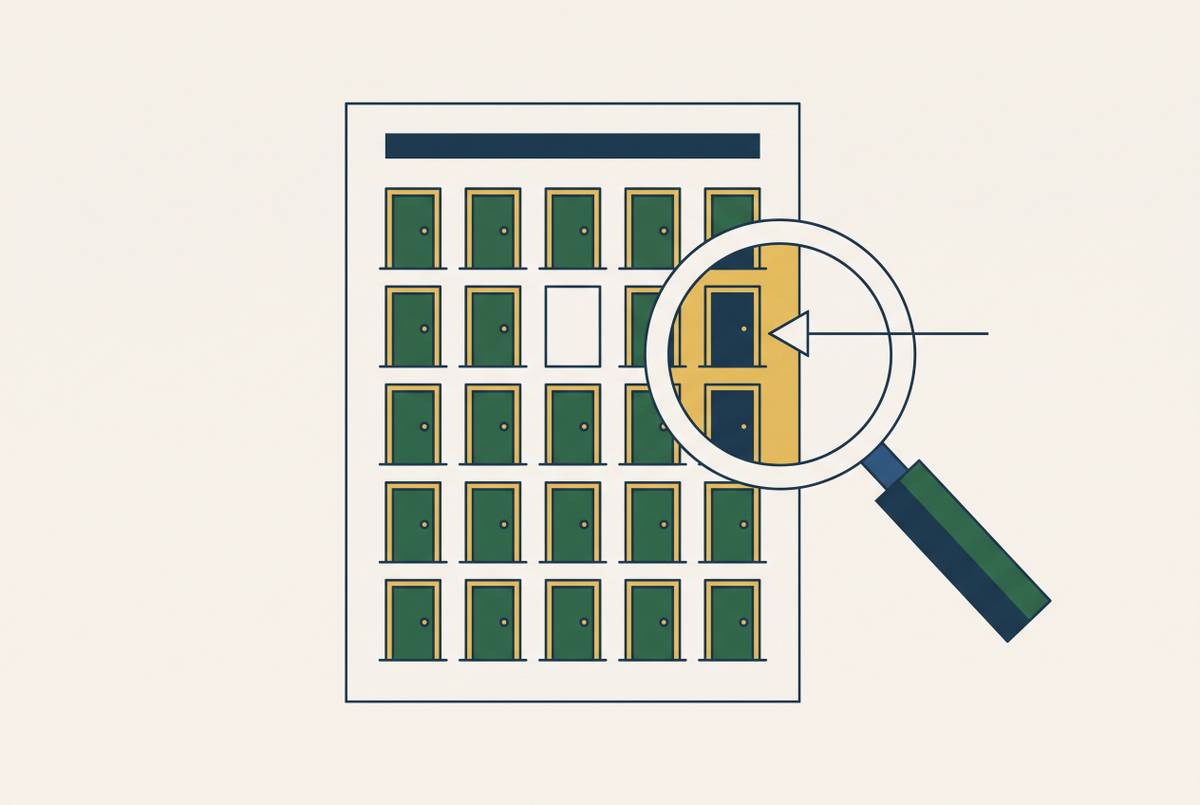
Plan-schedule divergence occurs when a door appears on a floor plan but not in the schedule, or in the schedule but on no plan. Both conditions can exist on the same job. A matching total can therefore conceal different opening identities, while enlarged plans and overlapping matchlines can introduce duplicates. The opening count formula addresses those distinctions as Verified Openings = Plan Count + Schedule-Only Units − Duplicates − Exclusions.
Set number mismatch leaves the opening present but its hardware unresolved. A door assigned group 107.3 in the schedule and 107.4 in the specification still counts as one opening, as does a door assigned a set that has no definition. The City of Santa Fe's Fire Station No. 2 specification, Section 08 71 00, lists door 146-1 under two sets and nine doors under a set captioned "(NOT IN USE)". Reading that caption literally leaves nine openings without hardware, while accepting the door list assigns them dozens of line items. The count cannot choose between those interpretations.
Electrified hardware under-carry is a third blind spot because some requirements are in the security or access-control specifications. Under bid pressure, those sections may receive less attention than the door schedule. An opening can consequently remain in the takeoff while its electronic access control hardware is under-carried. A totals-based review tests presence.
Why finish gaps and quantity conventions add silent pricing errors on top of missed items
A takeoff can include every opening and still have errors in how the hardware is priced. Blank finish lines require resolution, while a finish code may be defined far from the item that uses it. The Santa Fe specification uses EN on many lines but defines it through a manufacturer table elsewhere in the section. The information exists, but the pricing line does not explain itself.
Quantity conventions create a different kind of ambiguity. The trade has not fully settled whether hardware quantities should appear per opening or as totals across all openings assigned to a set. A tool can use one convention while the estimator assumes the other, producing arithmetic that is internally consistent but priced on the wrong basis. Getting the convention backwards multiplies downstream numbers by the set count. Nothing in the arithmetic exposes the mistaken interpretation.
In a hospital package with eleven separate schedules across multiple pages, that quantity problem grows as the documents get more complex. More schedules extend the convention's effect through the package, just as repeated finish codes extend an unresolved finish assumption across hardware lines. Both errors can leave the output looking complete, with no missing row to draw attention to them.
How institutional owner standards change the problem from extraction to authorship
On institutional jobs governed by owner standards, the project specification is not the final source of hardware selections. Cornell's Design and Construction Standards define mandatory design constraints and acceptable or required products for construction at Cornell. Its hardware sets state no finishes, and every hinge line reads "As Required". Those entries cannot simply become priced selections. The estimator must build a set from the options allowed.
Michigan State presents the same challenge in a different form. Its door hardware document contains a 13-page Part 1 General section organized by component type, with no numbered hardware sets. Matching a door to hardware therefore requires interpreting its usage against component-level requirements, then repeating that work for each opening. There is no set number to extract.
The estimator must work from owner standards, building security requirements, and the codes that apply, which takes more than copying the contents of a numbered group. Fire-rated assemblies also require verification that components come from listed manufacturers, so assembling sets adds a compatibility burden at the opening level. Extraction reproduces a selection already made. Authorship creates the selection from constraints.
What the document problem costs distributors and subcontractors specifically
Distributors and Division 8 subcontractors sit downstream of the specification and upstream of the GC's schedule, absorbing complexity from both directions. When a hardware set is misread, the error found during bid review is a bad number. Found at submittal, the same error consumes time on a live project. Custom frames, specialty glazing, and electrified hardware have long lead times, and electronic access control hardware may take longer to get than mechanical hardware. A late discovery therefore affects more than the cost of the omitted item.
The door, frame, and hardware require matching fire labels and installation per listing. An error that moves from takeoff into an order can void the assembly's listing. The detailed submittal then makes discrepancies visible by identifying each door's hardware, manufacturer, model, finish, function, and deviations from the specification. Takeoff assumptions become part of the project record.
At distributors, the person doing this work is often a salesperson fitting takeoff between calls. Quote requests get sorted by the time they require rather than their value, leaving larger jobs waiting longest. Meanwhile, the pipeline of biddable work is growing while estimating headcount at most distributors stays flat. The resulting pressure is structural, because the same staff must reconcile more document relationships without surrendering pricing accuracy.
Why general-purpose takeoff tools and opening-count platforms cannot close the gap
General-purpose takeoff and opening-count tools address a narrower question than hardware reconciliation. They establish how many openings of each type appear on the plans. That is useful work, but an accurate count does not establish whether the hardware assigned to each opening is defined, compatible, or in scope. Counting and reconciliation are different operations.
The evaluation must establish whether the workflow reads the written hardware specification together with the door schedule, rather than assume that takeoff capability includes that comparison. General-purpose and opening-count workflows leave that cross-document step with the estimator. The limitation concerns category capability.
Hardware takeoff is a relationship problem because a set belongs to a particular opening with a size, fire rating, frame type, function, handing, and use case. Copying a hardware group reproduces its contents without necessarily testing that relationship. A copied set can therefore be legible and complete while remaining the wrong set for the door. The unresolved gap is between an opening's identity and the requirements attached to it.
What document-simultaneous reconciliation actually does differently
Document-simultaneous reconciliation makes those relationships checkable in one pass. It pulls hardware sets from Section 08 71 00 or from the drawings, depending on where the project places them, and compares their assignments with the door schedule. Missing set definitions and conflicting set numbers become discrepancies rather than invisible assumptions beneath an unchanged count. Doors assigned to two sets are surfaced as conflicts. Sets captioned "(NOT IN USE)" are flagged.
The same pass takes opening attributes from the documents that give them. Handing comes from the floor plan, leaf count from the elevation, and wall type from the opening's partition tag checked against the partition schedule. Pair detection demonstrates why this is necessary, because one opening can contain two leaves even when the schedule does not identify it as a pair. The floor plan symbol may show both leaves as well.
Scope reconciliation also identifies hardware lines designated OT or assigned to another trade, preventing them from being priced as part of the hardware package. On institutional work, authorship support checks how each door is used against owner-standard component tables, going beyond copying set numbers. The speed gain follows because moving repeatedly among five documents by hand becomes a single reconciliation pass, allowing completion in a fraction of the time.
Addressing the verification paradox objection
The verification paradox is a serious objection to AI-assisted takeoff. Research published in 2026 involving twelve professional estimators describes the paradox as re-performing manual takeoffs to validate AI outputs. Dodge Construction Network / CMiC's 2025 survey found that a substantial share of surveyed U.S. contractors identified reliability or accuracy as their chief concern with AI tools. If checking the output means doing the original task again, it is hard to save the time claimed. Skepticism is justified when the output leaves the decisive checks undone.
The distinction is between extraction accuracy and judgment accuracy. Reliable opening counts do not establish that a set-number conflict or a "(NOT IN USE)" caption has been handled correctly. A platform that reconciles documents instead provides relationships for the estimator to inspect, including whether a particular door's assigned set matches the specification. That does not eliminate the need for verification.
It changes what verification examines. Rather than reconstructing the takeoff to discover whether anything was missed, the estimator can assess a reconciled output against the job's requirements. The paradox therefore identifies a tool-specific weakness.
What estimators and distributors should actually look for in a Division 8 takeoff platform
For teams selecting a platform, the practical evaluation should center on an opening-by-opening matrix. Each opening needs its schedule assignment reconciled with the written hardware specification, including missing definitions, conflicting numbers, and sets marked "(NOT IN USE)". The matrix should also bring together handing, leaf count, and wall type from the documents that contain them. Manual entry is not the same as reconciliation. Frame-related attributes remain unresolved if the estimator still has to reconstruct the partition relationship separately.
Pricing conventions deserve an equally explicit check. The platform should make quantity-per-opening versus total-quantity treatment visible and auditable. It should also flag scope-bleed lines, including OT designations and items belonging to other trades. A hardware set can contain those lines without making them part of the distributor's price. Accurate extraction alone would reproduce the scope error.
Institutional capability requires a separate test of authorship support. The platform must handle owner-standard component tables and door usage as well as project specifications with numbered sets ready to copy. Before bid submission, the useful output is one in which the estimator can inspect the connection between each opening, its frame requirements, and its hardware scope without rebuilding that connection by hand.