Hardware Lead Time Volatility and Its Impact on Division 8 Bid Pricing
Structural supply chain shifts now force Division 8 estimators to price lead-time risk at takeoff.
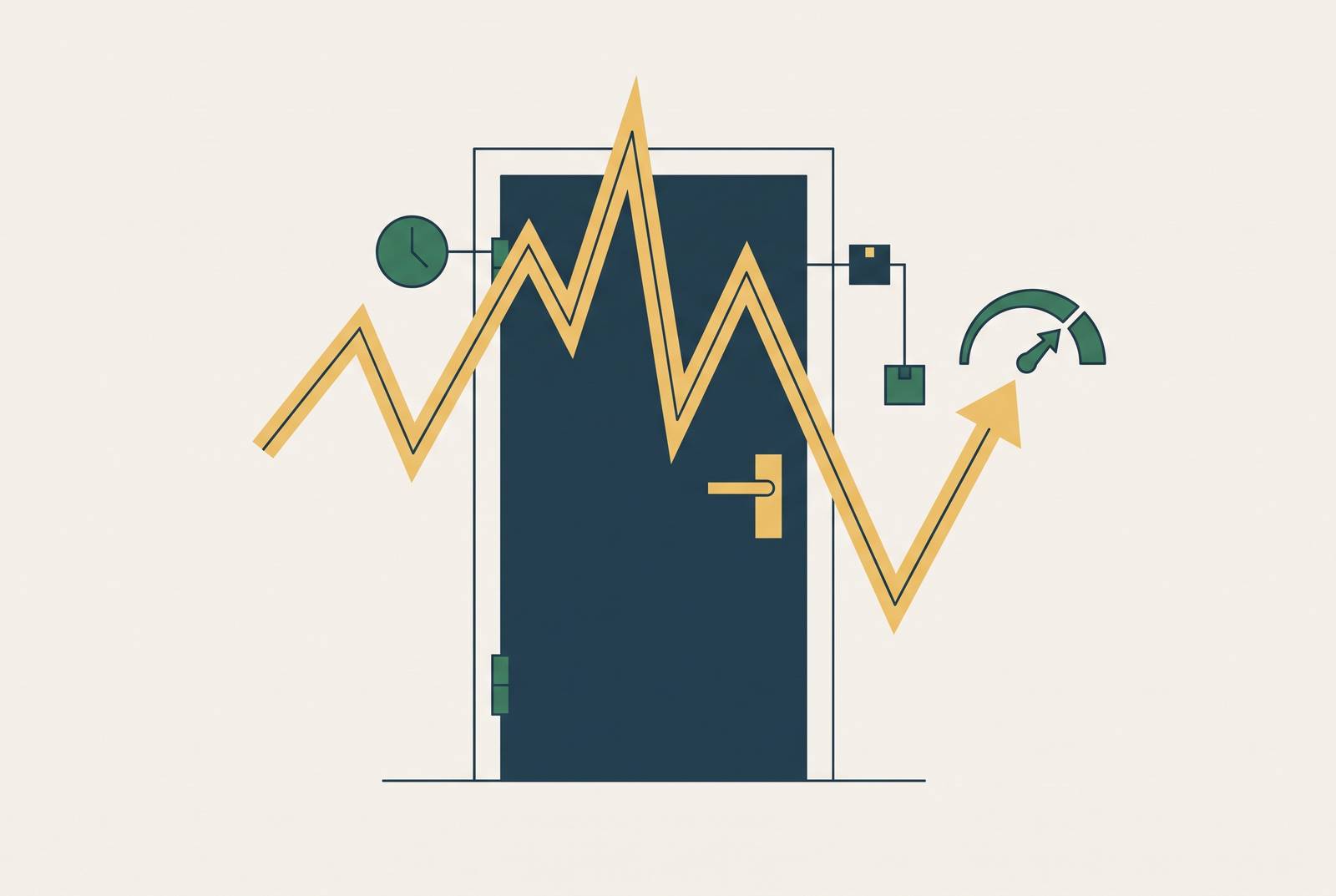
Lead time volatility in door hardware has moved from an occasional disruption to a permanent feature of how the supply chain works, and Division 8 bids built around stable lead times are now systematically mispriced. The old assumption, that a quote today reflects the cost and schedule reality at order time, no longer holds across enough of a hardware package to ignore. Tariffs are the sharpest near-term accelerant in that mix. U.S. Section 232 tariffs on steel and aluminum, in place since 2018, have had a direct, downstream pricing effect on hollow metal doors, which are made primarily of steel, and that effect has not faded with time the way a temporary price spike would.
The consequence for an estimator is that a bid priced on last quarter's lead times carries risk the contractor may not know it is holding. The forces behind it are structural: policy decisions, material markets, and manufacturing capacity limits interact in ways that keep lead times in continuous motion. One who treats it as noise will keep absorbing the gap between the quote and the invoice as lost margin, bid after bid, without ever identifying where the exposure came from.
Finish selection and product complexity turn a single opening into a schedule risk
Lead time risk inside a single hardware package is not spread evenly across every item on the schedule. It concentrates in specification choices, finish, product type, electrification, that look like ordinary design decisions, and few estimators recognize them as supply chain red flags. A passage set and an electrified mortise lock can sit two lines apart on the same hardware set and carry wildly different production timelines, and nothing on the page signals that difference to an estimator moving quickly through a takeoff.
Product complexity is a large part of why. Lead-lined door material currently runs a 12-week lead time on its own, and surface finishing processes, PVD coating especially, take longer to run than standard plating. That added time rarely makes it into schedule planning because an estimator reading the spec sees a finish selection, not a manufacturing bottleneck.
The longest-lead item in any given opening sets the procurement schedule for the entire assembly around it. On a complex institutional package, that governing item is often identified only after award, when the contract price is fixed and there is no longer room to adjust it. The information needed to catch this is sitting in the spec and the hardware schedule, waiting for someone to read it at the opening level.
Document conflicts that hide the longest-lead items until after award
The long-lead items that blow up a Division 8 bid are rarely buried in the supply chain. They are buried between documents that most estimators do not read side by side, and the conflict between those documents is where the financial exposure actually lives. The door schedule functions as the bridge between the architectural drawings and the hardware specification: an architect assigns a hardware group, HW-3 for example, to an opening on the schedule, and the hardware distributor then turns to that group inside the 08 71 00 specification to determine what has to ship. Errors and inconsistencies between the schedule and the spec are a well-documented source of project delays and change orders, not an occasional nuisance.
A sound review starts with the door schedule and then works outward through every document that touches each opening: floor plans, wall types, reflected ceiling plans, room data sheets, life-safety drawings, finish schedules, hardware sets, the specification itself, addenda, and any consultant sketches issued along the way. The items that carry the longest lead times, electrified hardware, specialty frames, lead-lined assemblies, fire-rated glazing, are also the items most likely to be introduced in the hardware spec without ever showing up on the door schedule or the electrical drawings. That makes them effectively invisible to an estimator who is reading any single document in isolation.
Electrical drawings compound the problem in their own way. Electrified hardware, already the most schedule-sensitive category in the package, ends up being the category most likely to fall into the gap between electrical and architectural documentation. General contractors who bid hardware off the door schedule alone, without reading the full Division 08 specification, routinely miss BHMA grade callouts, fire rating specifics, finish premiums, and "no substitution" clauses buried in the spec language. The bid comes in low on paper, and procurement runs over budget in the field.
Handing is read off the floor plan, not the door schedule. Leaf count comes off the door elevation. Wall type comes from the partition tag at that specific opening on the plan. These are not gaps in the door schedule's information so much as questions the door schedule was never designed to answer, because the answers belong to entirely different documents. An estimator working from the schedule alone is not missing details through carelessness. The documents were built to be read separately, and the exposure accumulates in the space between them.
Building lead-time risk into the bid before the documents are reconciled
Surfacing long-lead items during takeoff, before a number goes out the door, is the only point in the process where an estimator can price the risk. An opening-by-opening review conducted at takeoff, rather than a simple door count, is what surfaces the conditions that extend lead times: electrification, specialty finishes, lead-lining, rated glazing, non-standard frame depths, oversized openings, and owner-specific locking systems.
For each opening, confirming the door and frame material, profile, size, handing, swing, wall construction, opening rating, glazing requirements, hardware set, security function, keying requirements, and electrification before tender close is the step that separates a real opening matrix from a door count with a price attached. An opening matrix that distinguishes confirmed requirements from tender assumptions and from unresolved document conflicts gives the estimator a defensible record of what was priced and what was qualified. That record is the foundation for a scope letter that actually protects margin.
Hidden costs appear in the first bid cycle rather than the first pass of any single estimate: keying setup and master key system design, hardware schedule revisions triggered by addenda, frame and door prep mismatches, and cylinder keying labor all add materially to a hardware bid in ways estimators frequently miss the first time through. None of this is about eliminating lead-time risk from the bid. It is about knowing precisely which openings carry that risk, so those openings can be priced, qualified, or scheduled differently from the standard ones sitting next to them on the same schedule.
Scope language and pricing structures that transfer lead-time risk to the right party
How a bid is written determines who absorbs the cost when a lead time shifts after award, and most Division 8 bids are written in a way that leaves the contractor holding that exposure by default. Fixing this does not require aggressive contract language. It requires scope language that states the facts of the current supply environment clearly enough that they become part of the agreement.
Quote validity is the first lever to pull. Escalation clauses tied to specific, named triggers, tariff rate changes, manufacturer price increase notices, or quote expiration dates, give contractors a contractual mechanism for passing the cost of a post-award price change to the owner instead of absorbing it inside the original contract sum.
Owner-furnished, contractor-installed procurement should be identified explicitly for the highest-risk items on the schedule. The contractor loses the markup on that item, and the owner gains the risk. That trade should be named in the bid, not left implicit. Early procurement authorization language, requesting the owner's sign-off to purchase long-lead items before the full submittal cycle closes, is what makes all of the previous identification work actionable. Finding a 12-week lead-time item during takeoff protects nothing on its own if there is no contractual path to ordering it before the submittal process finishes running its course.
Procurement timing as a pricing strategy: how sequencing orders changes bid economics
An estimator who knows which items are long-lead before award can sequence procurement in a way that locks in the price quoted at bid time. An estimator who discovers that same item after award is repricing it against whatever the market is charging on that day, with none of the leverage a pre-award quote provided. Procurement timing, viewed this way, is a pricing decision made at the moment of award, not a logistics task handled later by someone else on the project.
Phased procurement is the execution strategy that turns early identification into real savings. Confirming specifications early, approving drawings promptly, consolidating product requirements, and forecasting demand ahead of need are buyer-side behaviors that reduce lead time across the supply chain, and they belong to procurement decision-making as much as to estimating.
The economics favor acting early. The cost of early procurement, carrying inventory, coordinating storage, is quantifiable and finite; it can be estimated and priced into the bid with reasonable confidence. If you reprice a long-lead item after award, against a shortened quote window and a market that has moved, the cost is open-ended, and it gets absorbed silently as lost margin instead of being flagged as a line item anyone tracks. Large-scale projects often require phased production planning on the manufacturer's side as well. Placing an order early does more than protect a price. It secures a production slot that may simply not be available if the order comes in late.
What a complete opening count does beyond a door count
Every strategy described so far, pricing lead-time risk into the bid, writing scope language that transfers risk appropriately, sequencing procurement to protect margin, depends on knowing what is in each opening before the bid goes out. That knowledge requires reconciling the door schedule, the plans, the specification, and the elevations against one another, and a document-by-document takeoff process fails at this systematically, not occasionally.
A takeoff built on the door schedule alone cannot fill in the columns that actually govern lead time. Handing comes from the floor plan. A schedule-only takeoff also cannot catch the hardware set conflicts, the missing doors, or the schedule-to-plan discrepancies, and that is exactly where long-lead items tend to hide. Surfacing this information for every opening, finish type, electrification status, frame complexity, requires reading the door schedule, the hardware spec, the electrical drawings, and the partition details at the same time, a task that strains the limits of manual review once a project grows past a modest size.
Fresco runs a takeoff across the door schedule, door and frame elevations, partition schedule, floor plans, and the 08 71 00 specification simultaneously, normalizing them into a single opening table that flags conflicts between documents instead of letting them pass silently into the count. The items most likely to carry the longest lead times, electrified hardware, specialty frames, lead-lined assemblies, are also the items most likely to be scattered across the hardware spec, the electrical drawings, and the partition schedule without ever appearing on the door schedule itself. Systematic reconciliation of those documents against each other is the first line of defense against discovering that scatter after award, and it marks the difference between pricing lead-time risk accurately and finding out about it on a change order. The speed gain compounds the strategic gain: a takeoff that once took more than a day to complete running in under an hour means an estimator can apply the opening-by-opening review described throughout this piece to every bid on the board, not only the handful large enough to justify the time under the old process. For a solo estimator or a smaller shop, that is the real point of leverage: the lead-time pricing strategies available to large contracting firms rest on the same foundational requirement, a complete, reconciled opening list, that used to be too time-consuming to produce on every job.
Treating lead-time volatility as a permanent input, not a temporary problem to survive
Estimators who protect margin in a volatile supply environment are not the ones who guess lead times correctly more often than their competitors. They are the ones who have built a process that does not depend on that guess holding true. Escalation clauses, opening-level reconciliation, phased procurement, and substitution provisions are not emergency measures for a difficult stretch in the supply chain. They pay off whether or not the market stabilizes, because they price the uncertainty directly.
The shift from a door-count takeoff to opening-level reconciliation is the operational change that makes every other strategy in this piece possible. Without it, scope qualifications amount to guesses dressed up as precision, and procurement timing stays reactive no matter how well the contract language is drafted. With it, an estimator can name the specific openings that carry risk, price them accordingly, write scope language that reflects reality rather than hope, and sequence procurement to protect the number submitted at bid time.
Volume follows from this, and it compounds. An estimator who can produce a reconciled opening list fast enough to bid more jobs wins more work without logging more hours doing it, and the lead-time strategies that protect margin on each bid make that volume sustainable as well as fast. The posture that matters is the one that treats lead time volatility as a known, permanent input to be priced, not a disruption to be weathered until conditions improve. Conditions are not improving on a fixed timeline, and the estimators positioned to win in the meantime are the ones who stopped waiting for them to.