When to Requote a Division 8 Hardware Bid After Award Delay
Check for three specific triggers before defending a delayed Division 8 hardware bid.
A delayed award does not automatically mean a Division 8 hardware bid needs to be requoted, but it does mean the number has to be checked against three specific triggers before anyone can call it defensible: a manufacturer surcharge event, an expired quote validity window, or spec drift introduced through addenda and RFIs during the delay. Estimators who treat every delayed award the same way, either holding the number out of habit or requoting out of anxiety, are both making the same mistake: deciding without checking. This piece lays out what those triggers are, how to check for them in order, and why the time cost of that check has changed enough to make skipping it indefensible.
Why award delays create genuine pricing risk for Division 8 hardware bids
A Division 8 hardware bid is assembled from components that each carry their own pricing calendar: closers, locksets, exit devices, hinges, electrified hardware. Each comes from a manufacturer that sets its own list prices and its own surcharge schedule, independent of what any other manufacturer in the package is doing. That structure alone distinguishes hardware pricing risk from the pricing risk most other trades carry, where a delay simply means waiting on a single, more uniform commodity index.
The hardware schedule compounds this. Hardware is organized into groups, labeled HW-1, HW-2, and so on, and each group is a bundled assembly covering every component required for a given door type. When one component inside a group changes price, say the exit device line inside a given hardware group, the change doesn't stay contained to a single quote line. It applies to every opening the estimator assigned to that group, which on a mid-size commercial project can mean dozens of doors moving together.
That's the multiplicative structure that makes Division 8 bids unusually fragile during a delay. A surcharge on one product line doesn't raise one price, it raises the cost basis for every opening tied to the group that product line belongs to. This multiplier effect is why Division 8 takeoffs demand specialized handling: a general-purpose estimating process that treats hardware as a flat list of line items has no way to see that a single manufacturer event just touched forty openings at once, because it never captured the group-to-opening relationship that makes the exposure multiply.
None of this means every delay carries the same risk. A two-week slip on a project bid during a quiet, stable pricing period is a different animal from a 90-day slip that overlaps a period of active, named manufacturer surcharge activity. What an estimator needs is not a rule of thumb tied to elapsed time, but a set of identifiable triggers that can be checked against the calendar, the contract, and the document set. The rest of this piece works through those triggers in turn.
How manufacturer surcharge announcements create hard, dated invalidation points
The cleanest invalidation trigger in Division 8 pricing is the manufacturer surcharge or list price announcement, precisely because it isn't vague. A bid issued before one of these announcements carries a number the manufacturer has, in effect, already withdrawn, even if no one has said so out loud.
The check this requires is mechanical. Fresco's automated reconciliation of door schedules, plans, and specs keeps every hardware group assignment traceable back to its source documents, which is what makes it possible to answer, with confidence, which manufacturers are specified and whether any of them have moved on price since the bid went out.
Surcharges and list increases behave differently depending on the contract structure that governs them. On institutional work procured through statewide cooperative contracts, such as Washington's Contract 29723 for Doors, Frames, and Hardware, pricing is set as a discount percentage off list. An estimator working from a cooperative contract has to watch list price movement specifically, separate from watching for surcharges, because the two affect the bid through different mechanisms.
The objection to treating surcharge dates as hard triggers is that surcharges sometimes get reversed or absorbed by the distributor before they ever reach the subcontractor. Absorption is a fact to be verified, not a default to be assumed.
How quote validity windows create a second, independent trigger
Manufacturer surcharges aren't the only way a number stops being valid. Every quote a distributor issues carries a validity window, whether it's stated explicitly on the quote sheet or implied by standard distributor practice, and once that window closes, the price inside it is no longer a commitment. At that point the number becomes a reference point that has to be reconfirmed before anyone can submit it as part of a bid.
This trigger operates independently of surcharge activity. Formal validity periods of this kind appear across the industry, including in the extended structures common to institutional procurement, and they function as a hard deadline regardless of what the broader cost environment is doing.
The practical response is simple: if the award is delayed past the distributor's stated validity period, the first call is to the distributor, not to the takeoff software. Everything downstream, whether this becomes a quiet reconfirmation or a formal requote, follows from the answer to that one question.
How spec drift during a delay changes the scope
The first two triggers are both price problems: a number that was accurate when written is no longer accurate because a cost moved. Spec drift is a different kind of problem: during a long award delay, the documents that governed the original takeoff can simply stop matching the project. Addenda get issued, consultants respond to RFIs, design revisions move forward, and any of these can alter hardware sets, door types, or opening requirements without anyone formally notifying the hardware subcontractor that a requote is needed.
Door schedules and hardware specifications are already a common source of inconsistency even without a delay in the picture, and those inconsistencies are a documented cause of change orders on commercial projects. A revised fire-rating requirement, a new electrified hardware preparation, an electrical drawing change that affects door coordination: any one of these can silently move the scope out from under the number that was quoted.
The documents worth auditing after a delay include addenda to the door schedule (new openings, deleted openings, reassigned hardware groups), RFI responses touching fire-rating or electrified hardware preparations, Division 10 or electrical drawing revisions affecting opening coordination, and consultant sketches or room data sheet updates that change what's required at individual openings.
A cost escalation percentage applied to the original number does nothing to fix this kind of exposure. If an addendum added three openings that the original takeoff never counted, applying a surcharge adjustment to the old count doesn't produce an updated bid, it produces a more expensive version of a bid that was already missing work. Spec drift requires going back to the opening count itself and rechecking it against the revised documents, not adjusting the price on a scope that may no longer be correct.
Under normal conditions, the distributor and consultant catch these document conflicts during the submittal phase, cross-checking the door schedule against the hardware specification before anything gets ordered. Catching it earlier requires reading the schedule, the spec, and the plans together rather than working through them one at a time, which is a harder discipline to maintain manually than it sounds. Fresco's Division 8 takeoff pulls the door schedule, elevations, partition schedules, floor plans, and hardware specification together as a cross-document audit, catching a mismatch between documents during the takeoff.
When the original number is still defensible
None of this argues that every delayed award needs a requote. If no manufacturer surcharge event falls between the bid date and the likely purchase order date, if the distributor confirms the price hold is still active, and if no addenda or RFI responses have touched the door schedule or hardware sets, the original number holds up without revision.
Requoting a scope that hasn't actually changed carries real costs of its own. The more defensible practice is to reserve the full, formal re-estimate for the point where a purchase order is actually imminent, rather than re-running it every time the schedule slips.
The conditions that support holding the original number are specific: distributor price holds confirmed still active, no manufacturer surcharge effective date falling between the bid date and the expected purchase, no addenda or RFI responses that touch Division 8 scope, and a delay that's short relative to the project's longest lead-time items, such as hollow metal frames, electrified hardware, or specialty finishes. Where any of these is uncertain rather than confirmed, the right move is a targeted reconfirmation: call the distributor, verify the price holds, check for addenda, and document what was found. That's a fraction of the work a full requote demands, and it answers the actual question.
The decision to hold or requote is the direct output of checking the three trigger categories laid out above. Confidence in a held number comes from having checked, not from having avoided the question.
A working decision sequence for estimators facing a delayed award
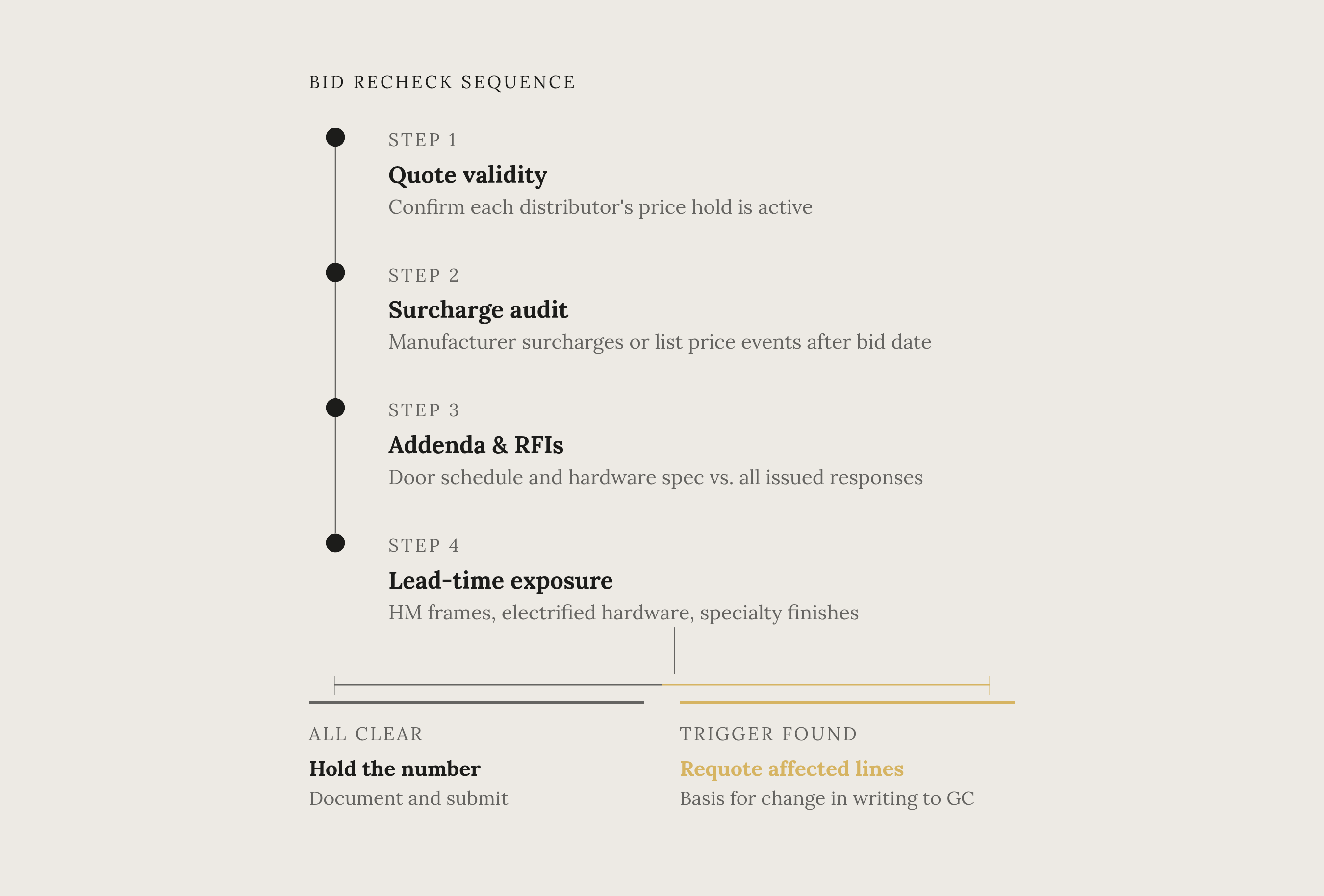
A delayed award should set off a structured reconfirmation process, worked in order, rather than an immediate requote or a default assumption that the original number still stands. The sequence stops as soon as a trigger is confirmed, or runs through to a clean hold if none turn up.
Step 1 is checking the quote validity window. Contact each distributor named in the bid and confirm whether the original price hold is still active. If it isn't, a requote on those specific lines is required before anything else proceeds. Confirmation needs to be in writing: a verbal assurance over the phone is not a commitment anyone can rely on later.
Step 2 is auditing for manufacturer surcharge events. Identify every manufacturer specified across the hardware groups and check whether any of them announced a surcharge or list price change after the bid date. On institutional projects running through cooperative contract structures, this step also includes checking whether a list price increase has moved the effective cost even where the discount percentage off list stayed the same.
Step 3 is reviewing the document set for addenda and RFI responses. Pull every addendum and RFI response issued after the bid date and check each one against the door schedule and hardware specification. Cross-referencing floor plans, wall types, life-safety drawings, finish schedules, hardware sets, specifications, addenda, and consultant sketches together, rather than working through them one document at a time, is what catches an opening that appears in one document but not another: that's a scope change, not an error to be resolved later. This is the step where reading the schedule, the spec, and the plans simultaneously matters most, and it's the step Fresco's cross-document takeoff process is built to support directly.
Step 4 is assessing lead-time exposure on long-lead items. A delayed award that pushes one of these items past its own price hold is a partial requote trigger on its own, even where the standard hardware lines are still covered.
If all four steps come back clean, the outcome is to document the confirmation and hold the number. If any step turns up a confirmed trigger, the outcome is to requote the specific lines that trigger affects, not necessarily the entire package, and to put the basis for that change in writing to the GC before the revised figure goes out. The value of running the sequence this way is that it protects the estimator from quietly absorbing costs that were never priced into the bid, and it protects the relationship with the GC by making the reason for any change explicit and documented.
How faster re-takeoff changes the calculus on requoting
The strongest practical reason estimators avoid this kind of rigorous post-delay review is time. Re-running a Division 8 takeoff has historically meant real hours of estimator labor, and that cost has to be weighed against the odds that the review turns up nothing. But that argument rests on an assumption that no longer holds up: that re-checking a bid takes as long as writing it the first time did.
The traditional version of a Division 8 takeoff requires manually reconciling the door schedule, the hardware specification, the floor plans, and any addenda before a count can even start. That reconciliation work is the same work the trigger check depends on. An estimator who skips that review to save time is accepting unknown scope risk and hoping it doesn't surface later, not holding the original number with confidence.
AI-assisted takeoff platforms built specifically for Division 8 change the arithmetic on that tradeoff, because they read the schedule, the spec, and the plans simultaneously rather than working through each document in sequence. That compresses the reconciliation step enough that a post-delay re-audit becomes something an estimator can run as a matter of course, rather than a half-day commitment that only gets made when a purchase order is already in hand. Fresco is built around this specifically, pulling data from door schedules, elevations, partition schedules, floor plans, and the 087100 hardware specification at once, so the cross-document check that catches scope drift happens inside the takeoff itself, as part of the same task. Once the review is fast enough that it is no longer expensive, the decision between holding a number and requoting it comes down to what the documents and the market actually say.