Building a Hollow Metal Unit Price Sheet That Holds Through Bid Day
Separate five cost drivers to survive late changes and steel price swings.

Pricing hollow metal doors and frames for a commercial Division 8 bid requires an opening-level assembly sheet built from reconciled plans, schedules, and specifications. The sheet must price gauge, frame construction type, wall condition, fire rating, and hardware prep separately, with material distinct from installation labor. With the sheet set up this way, an estimator can account for addenda and changes in steel prices without rebuilding the estimate.
Why hollow metal unit price sheets fail before bid day arrives
A late revision can force a full estimate rebuild or leave a cost increase buried in the bid margin. A single “HM door” line and a single “HM frame” line offer no clean way to absorb a wall-type change, a gauge upgrade, or steel movement. Each opening is an assembly whose parts move independently, but a broad average erases those distinctions.
The missing distinctions begin in the inputs. Floor plans, door schedules, and specifications must be read together before what they require can be priced in separate units. AI-powered Division 8 takeoff platforms like Fresco check those documents against each other at the same time because no one document has all the requirements.
The variables that actually move HM costs, and why they must be priced separately
Steel gauge and frame construction type each affect the cost. A gauge upgrade may come from wall location, occupancy, or an owner standard, none of which a generic frame rate can isolate. Welded and knock-down (KD) frames also have different material costs, installation labor profiles, and fire rating ceilings. Welded frames serve new masonry construction and high-security and high-demand fire-rated openings such as stairwells, while KD frames serve retrofit work in drywall and stud walls. Blending them produces a rate that is too high for KD and too low for welded.
Wall condition adds another fabrication requirement. CMU calls for masonry anchors, while metal stud walls call for stud anchors. That distinction affects material and lead time independently of gauge. Fire rating, in turn, governs construction requirements, UL listing requirements, and the hardware permitted in the assembly. Grout fill for fire-rated welded frames is a material and labor requirement.
Hardware prep is the fifth variable because the frame must accommodate the specified hardware at the factory. Hinge, strike, closer, and coordinator locations cannot be treated as unspecified field work. Changes made in the field can weaken the assembly and void fire ratings, while missing preps lead to rework that a blended rate cannot predict. Hardware set cost must also have its own line outside the slab or frame total. These five attributes are therefore the columns the sheet needs, with distinct pricing lines beneath them.
How to estimate hollow metal doors and frames with a line for each variable
Each opening ID from the door schedule should have its own assembly. Pricing by actual opening differs from pricing by door type because the opening carries its own wall condition, rating, and prep requirements. Floor plans give the tags and locations, schedules give the dimensions and types, and specifications give the construction requirements and hardware sets. An opening marked “HW-3, 90-minute, hollow metal” cannot be priced completely until its hardware group is matched to 08 71 00. The opening ID holds those reconciled requirements together without collapsing their costs.
In that assembly, the door slab needs a line for gauge, one for core type, and one for special construction. Honeycomb, polystyrene, and steel-stiffened cores are distinct material choices, as are steel-stiffened hurricane, lead-lined, and ballistic construction. Architectural-grade material quality, reinforcements, and certifications belong in the applicable unit. The frame needs separate units for welded and KD construction, gauges of 14, 16, and 18, and throat depth based on the actual wall assembly measurement. Three-sided frames and elevation frames must also have their own rates outside the standard frame rate.
Factory prep belongs on the material side, with separate adders for standard hinge prep, closer reinforcement, coordinator, and electric strike. Fire rating adders for 20-minute, 45-minute, 60-minute, 90-minute, and 3-hour requirements should capture the applicable listing, grout fill, and hardware constraints. Each hardware set should then be priced as an assembled unit identified by its set number, contents, and finish. This keeps a set substitution to one pricing update while preserving its connection to frame prep. Institutional scope obligations, including keying conferences and owner-security-department routing, need their own lines or notes to show what would otherwise be an unspoken allowance in margin.
Installation labor must remain separate from material because a welded frame in masonry is not the same labor unit as a KD frame in a stud wall. That separation also defines the limits of an update. If a wall revision changes only throat depth and anchor requirements, the estimator updates only the frame throat and anchor type lines. If the revision also changes construction type or installation conditions, those lines move as well.
Spec variables that a sheet built only from the schedule will miss
The door schedule identifies the openings, but it does not contain every requirement needed to price them. Section 08 11 00 may require galvannealed steel with ASTM A653, A60 coating for exterior applications where the schedule gives no coating information. A price based on standard primed steel would leave out the cost of the required material. The specification may also require welded construction behind a frame type code that does not explain the fabrication method. Grout fill requirements for fire-rated welded frames add another cost that a schedule-only takeoff misses.
Section 08 71 00 lists what is in each hardware set named in the references. Knowing the number of sets does not establish the hinges, lockset grade, closer, exit device, seals, or finish within each set. BHMA operational grades impose quality requirements independently of brand, so discovering the grade late can force repricing. DHI’s Sequence and Format for the Hardware Schedule governs how hardware schedules are written and formatted. Project specifications that reference it may require rejection and resubmission for non-compliance, making submittal work a scope issue.
Institutional owner standards are a separate set of documents above the project specification. Universities, healthcare systems, and government facilities may impose facilities or security requirements that a project-specification-only read will miss. An architectural hardware credential reflects the specialization involved through a multi-part exam, including a 5-hour in-person Part 2 in which candidates develop complete hardware sets and door schedules, plus an additional in-person Part 3. Institutional hardware specification is not simply a counting task for a general estimating workflow. The sheet cannot be built on complete inputs until the schedule, specifications, and owner standards have been reconciled against the plans.
Steel market timing and lead time as a sheet-design problem, not just a contingency line
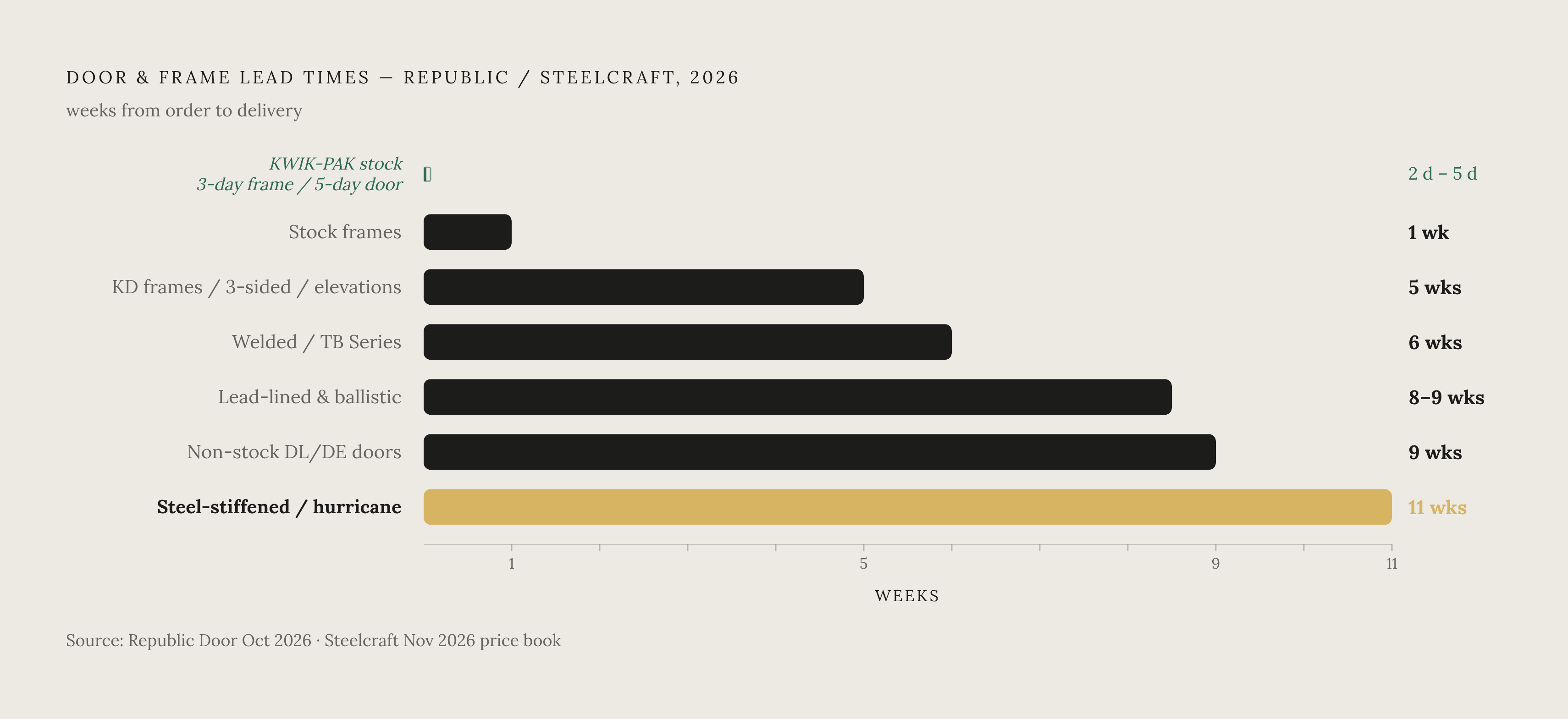
Lead time varies by program and opening type. Prime Door offers standard-size hollow metal frames ready same or next day through its Fast Frames program, while frames with non-standard dimensions, specialty gauges, and custom configurations may take longer to get. A sheet that groups them together cannot distinguish readily available material from material subject to a longer manufacturing period.
Republic Door’s October 2026 lead time data shows stock frames shipping in 1 week and KD frames, 3-sided frames, and elevations in 5 weeks. Its combined category for welded frames, 3-sided and elevations, and the new Thermal Break (TB) Series carries 6 weeks. The lead time for specialty frames, including lead-lined and ballistic, is 8–9 weeks. The lead time for non-stock DL/DE Series doors is 9 weeks, while steel-stiffened DL/DE Series doors, including hurricane construction, take 11 weeks.
Steelcraft’s price book, effective November 9, 2026, lists KWIK-PAK express stock with a 2-day lead time as well as 3-day frame / 5-day door express programs. Their premium pricing belongs in the applicable unit when the project schedule requires express supply. Steel Dynamics’ Q3 2026 earnings reported strengthened steel pricing, extended lead times, and tightened spot availability across flat-rolled and structural steel products.
The sheet should therefore assign escalation exposure to the relevant gauge, frame type, and configuration. Stock items and custom material do not need identical treatment merely because both are steel. The bid-to-award gap also matters because delayed contract execution can leave a locked price exposed to movement. Short decision timelines are a bid strategy, while the sheet should identify which units are most exposed if award slips. For long construction timelines, contract escalation clauses tied to a specific price index and clear adjustment triggers need the same opening-type distinctions.
How addenda and late document changes break a flat sheet and what structure prevents it
An addendum tests whether those distinctions are usable under deadline. If a corridor changes from stud wall to CMU, a flat frame rate hides the combined effects on construction type, throat size, anchors, and installation labor. The estimator must find those assumptions before working out the cost of the revision. On a structured sheet, the affected opening IDs already connect to separate frame, anchor, and labor units, allowing the estimator to update only the requirements that changed.
A fire rating increase from 45-minute to 90-minute follows a different update path. On a flat sheet, the estimator must reopen the frame and hardware assumptions for every affected opening. On the structured sheet, the rating adder and hardware set line carry the revision where those are the changed requirements. An exterior frame upgrade from 16-gauge to 14-gauge similarly updates the applicable frame unit. When a hardware set revision adds a coordinator, it changes the set price and shows the cost of the coordinator prep that goes with it.
These updates still depend on reconciling the addendum with the prior document set. Room functions, wall conditions, and hardware set numbers can change together, so reading the revised schedule in isolation is not enough. The estimator must hold the revision against the earlier plans, schedule, and specifications to establish its scope. A late addendum should then become a set of specific line changes rather than a reason to reread and rebuild everything. Granularity is not administrative overhead in that moment, but the mechanism that keeps the estimate editable before bid close.
How Fresco's document-simultaneous reconciliation produces the inputs a structured sheet needs
Reading plans first, schedules second, and specifications last separates requirements that must be understood together. A schedule code gains its full pricing meaning only when it is matched to its construction and hardware requirements. On institutional work, owner standards add a fourth layer that must remain distinct from the project specification.
Fresco is built exclusively for Division 8 and reconciles schedules, plans, and specifications simultaneously to produce opening-level attribute data. It reads the door schedule, elevations, partition schedule, floor plans, and 087100 spec together. That capability addresses the same relationship the sheet depends on, namely linking each actual opening to its frame, wall, rating, and hardware requirements. Its distinction between project specification requirements and owner standard requirements also bears directly on institutional scope.
An estimator who can reconcile the documents and build a structured sheet in under an hour rather than a full day can respond to more opportunities in the same period. Faster counting alone does not deliver that advantage if every revision still forces a rebuild. More bids quoted accurately is the advantage, and the sheet’s structure makes accuracy possible at that volume.