What Automated Door Schedule Validation Actually Checks That Your Estimator Cannot
Automated checks catch cross-document hardware conflicts your memory alone cannot hold.

Automated door schedule validation catches omissions before bid submission by checking each opening against its schedule entry, hardware set, specification, frame elevation, and fire-rating requirements together. Checking those records as one assembly instead of as separate line items reveals missing frames, incomplete hardware sets, and requirements that conflict.
Why door schedule validation is a cross-document problem, not a counting problem
Every commercial door opening must meet the requirements in four separate document sources. These are the door schedule, the 08 71 00 hardware specification, the architectural drawings, and the life-safety or fire-rating plans. Each describes a different part of the opening. The schedule establishes size, rating, and handing, while the drawings supply floor plan context, wall type, and frame elevation.
An entry identifying Door 101 as a 3'-0" x 7'-0", hollow metal, 90-minute fire-rated opening assigned HW-3 is therefore a pointer. HW-3 must be traced through the hardware schedule appendix to the specification, then checked for rated, coordinated, and complete components. The arithmetic can be correct while the assembly is wrong. A sequential, document-by-document review cannot, by itself, confirm cross-document consistency.
How a sequential human review creates structural blind spots
An estimator reads the schedule, follows hardware groups into the specification, and then checks the drawings. Each pass depends on what the estimator remembers from earlier documents. That dependence is the structural weakness of the process. By the third or fourth document, early detail degrades in working memory, especially when the schedule contains hundreds of openings.
Floor plans, wall types, reflected ceiling plans, life-safety drawings, finish schedules, hardware sets, specifications, addenda, and consultant sketches can each introduce a contradiction. The other documents need not signal that contradiction. So the same wrong hardware-set assignment can appear across dozens of identical openings even when each schedule row looks correct on its own. The estimator’s attention is not the failure point.
Late addenda make that dependence harder to manage. An estimator may carefully review a revised document without revisiting every opening affected by it. Reviewing the change does not propagate the change.
How automated validation reads all five document layers at once
“Simultaneous” describes automated validation’s single relational check of the schedule entry, hardware group assignment, specification section, frame elevation, and fire-rating designation for each opening ID. Every opening is tested against the rule sets. The check does not depend on selecting a sample or remembering which entries warrant another pass.
Computer vision can detect, count, and classify openings across a plan set. Validation logic then cross-references those openings against the schedule, hardware appendix, and specification. Detection supplies the openings to be tested. The linked check establishes whether their requirements agree, so a rating conflict appears as a conflict rather than as two correct-looking entries encountered separately. This distinction separates automated takeoff from the six validation checks that follow.
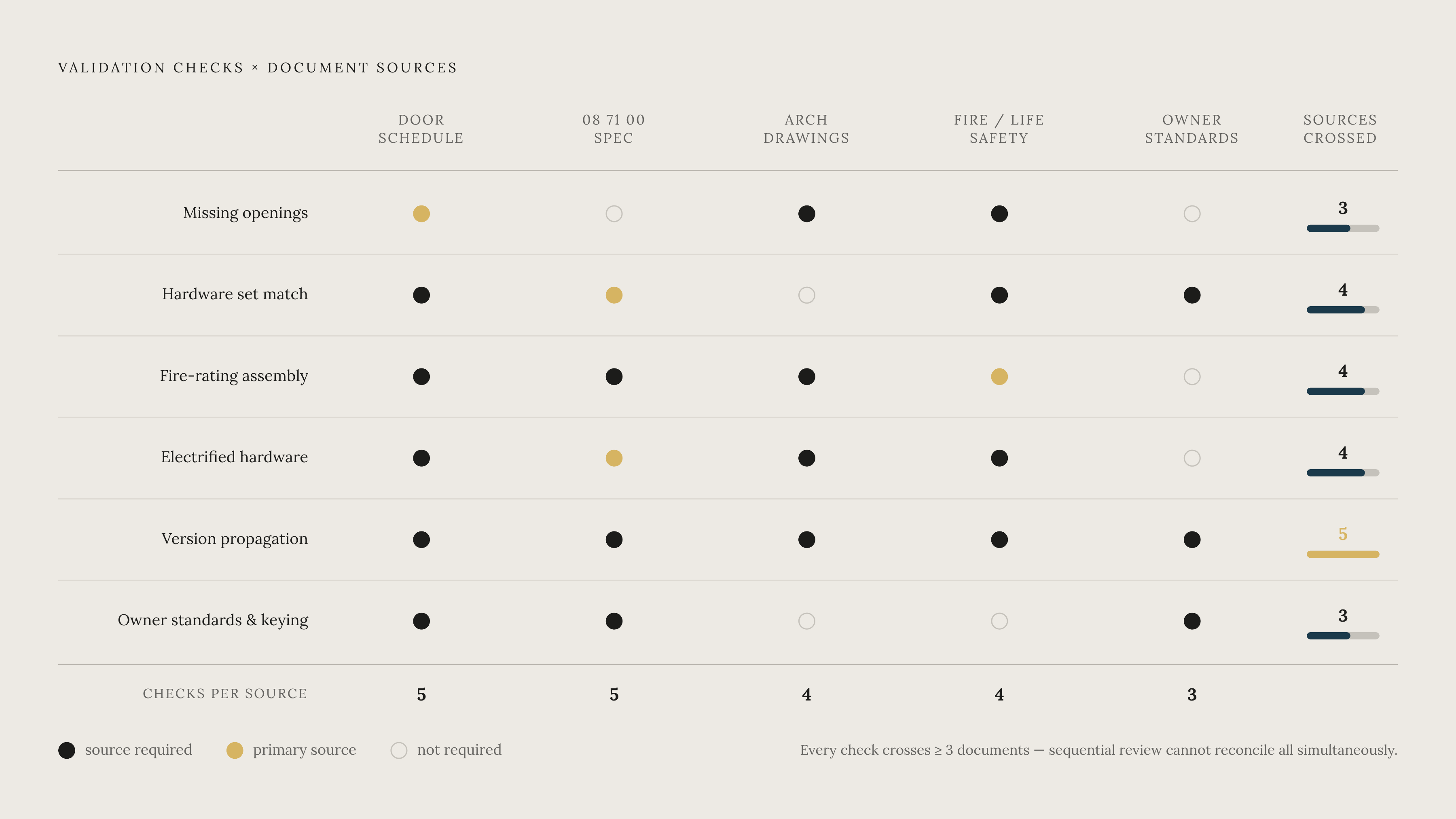
Check one: how to find missing openings before bidding across every sheet
Doors on enlarged plans can be absent from the schedule index, while overlapping sheets can cause the same opening to be counted twice. A schedule-only count cannot expose either discrepancy reliably. Its reference is the document that may be incomplete. Automated takeoff instead finds and counts door types across the full drawing set and groups the openings by type and hardware set.
That drawing-derived count can then be compared with the schedule. An opening present in one source but absent from the other becomes a specific discrepancy for review. Agreement on the total alone is not the test. The check concerns which openings appear in each source, because a missed opening at bid becomes a change order during construction. On a large commercial project, even a handful of omissions can create material cost exposure.
Check two: hardware set assignment matched to opening function and fire rating
A hardware group must satisfy both the opening’s intended function and its fire-rating requirements. Those are independent conditions imposed on the same set. Passage, privacy, classroom, storeroom, and corridor uses cannot be treated as interchangeable assignments. A hardware group can be fully described in the appendix yet still be wrong for the opening to which the schedule assigns it.
For example, HW-3 may include a passage lockset while the assigned opening is a fire-rated corridor door requiring a classroom or storeroom function. Automated assignment logic flags that mismatch at each opening that has it. This is also the assignment stage at which incompatible hardware, incorrect fire ratings, or omitted accessories such as gasketing and coordinators can enter the bid. Without the cross-check, those errors may go unnoticed until submittal review or until hardware reaches the site.
Check three: fire-rating assembly confirmed across leaf, frame, and hardware together
A fire-rated opening requires a labeled door leaf, a labeled frame, and hardware listed for use at the required rating. All three must agree for the specific opening. A correctly rated leaf does not compensate for a mismatched frame or unlisted hardware. Yet the leaf rating comes from the door schedule, the frame rating from its elevation or schedule, and the hardware listing from the specification or hardware group. Separate reviews can accept each source without proving that the assembled opening complies.
A three-way validation check tests those relationships together. If the leaf says 90-minute, the frame says 60-minute, and the hardware group is unlisted, the combination fails rather than passing as independently reviewed components. Related rules can flag glazing labels that do not align with the required rating, wrong handing or active leaf, and forgotten smoke seals on shaft doors. The Authority Having Jurisdiction may inspect the installed opening, so an unresolved mismatch can become a failed inspection long after bid-day pricing can change.
Check four: electrified hardware scope traced to power supply and controls
An electrified suffix, EL, on a lock or panic device creates requirements beyond the device itself. The specification must include an electrified hinge, door loop, or electrified power transfer device to complete the connection. Without that link, the hardware cannot function as specified. The omission may remain hidden until wiring begins, even though the lock or panic device was correctly selected and priced.
The scope is divided across documents and trades. Division 8 identifies the hardware device, Division 28 may include parts of the access-control system, and electrical drawings may show power supplies without clearly assigning device supply or raceways. A single-trade review therefore lacks the visibility needed to establish completeness reliably. Automated validation checks each electrified opening for a specified power transfer device, an identified fail state, and a door position switch, flagging absent or ambiguous elements. Tracing the opening to its power supply and controls exposes the distinction between a priced device and a complete working scope.
Check five: document version confirmed so addenda changes propagate to every affected opening
A correct assignment against an obsolete specification is still an incorrect basis for the estimate. Architectural schedules can reference hardware specifications that predate MEP revisions affecting door functions or performance requirements. Those changes can include manual to automatic operation or standard to acoustic-rated assemblies. Hardware configurations may consequently remain incompatible with revised door masses and requirements even when the opening count is unchanged.
Version drift is difficult to see in isolated passes. Rechecking an addendum can establish what changed without establishing which existing hardware assignments must change with it. The schedule and hardware group can each look correct because they belong to different stages of the design. Automated validation checks which document version an opening’s assignment came from and flags related specification or drawing revisions that lack a corresponding hardware-group update. It identifies the affected openings rather than leaving the estimator to reconstruct the reach of a revision across hundreds of entries.
Check six: owner standards and keying requirements matched to institutional specifications
Institutional work must also meet requirements beyond those in the project specification. An owner standard can mandate a manufacturer without substitution and require coordination with an existing keying system. A generic hardware selection may therefore be unacceptable. The check must compare the selection against the owner’s requirements for the same opening, rather than treating the project specification as self-sufficient.
University of Alabama’s Division 08 71 00 design guideline mandates Sargent cylinders with no substitution. The guideline requires master or grand master keying to the owner’s existing Sargent restricted keyway system and construction master keying of cylinders. Distributor keying is explicitly not acceptable. Pricing a generic cylinder selection without those requirements can produce hardware that fails at submittal.
Rutgers University’s Division 8 Design Standards Manual (December 2018) prohibits specifying hardware by allowance and requires hardware sets for each unique condition in the building. The manual also excludes floor-type or overhead concealed door closers. Those constraints are not generic counting rules. Automated validation compares the project specification with the owner standard and flags conflicts in manufacturer, grade, or keying requirements before bid submission. This check calls for Division 8 knowledge because a door symbol alone cannot show whether the hardware meets an institutional mandate.
Who absorbs the cost when these checks are missed
Division 8 subcontractors who bid on many jobs are the first to risk losses from pricing errors. Once a bid is accepted, its price stays the same even if openings were missed, hardware is incompatible, or the electrification scope is incomplete. Errors between the schedule and hardware specification become sources of delays and change orders. For an electrified opening priced without its associated power and controls, the omitted scope falls to the contractor who missed it.
Hardware distributors find the same errors at submittal. After award, the detailed submittal identifies every item by hardware group, manufacturer, model, finish, function, and deviation. That detail exposes incompatibilities concealed in the bid. When the wrong hardware is already on order, an assignment error becomes a loss. Review time also affects quote turnaround, so a slow reconciliation process can delay a quote beyond its useful bid window.
Project owners face the resulting delays and rework during construction. The Authority Having Jurisdiction checks fire-rated openings against the listed assembly, and components that do not comply must be corrected. Field corrections cost more than document-stage detection. When the conflict is discovered before pricing or at submittal, it is resolved at that stage, but when it is discovered after installation, correcting the same mismatch disrupts the work already completed.
What a Division 8-specific validation tool needs to know that a general-purpose tool does not
General-purpose takeoff can detect and count doors from plans. Those capabilities do not supply hardware assignment logic, fire-rating assembly rules, electrification completeness checks, or owner-standard cross-references. A tool must understand how an opening’s function constrains its hardware, how the rated components agree, and how revised or owner-mandated requirements change an otherwise plausible selection.
For an estimator or distributor evaluating software, the relevant test is whether it can apply those relationships to every opening before the bid goes out. The tool needs to link the schedule, hardware sets, specification, and frame elevations with fire-rating requirements, then extend the comparison to applicable electrical, access-control, addenda, and owner documents. Otherwise, someone still has to do the cross-check by hand even though the count is automated.
The competitive advantage is consistency across the bid workload. When the six checks can run on every bid, rather than only on high-value jobs with time for extensive review, estimators and distributors can quote more work with the same level of confidence.